
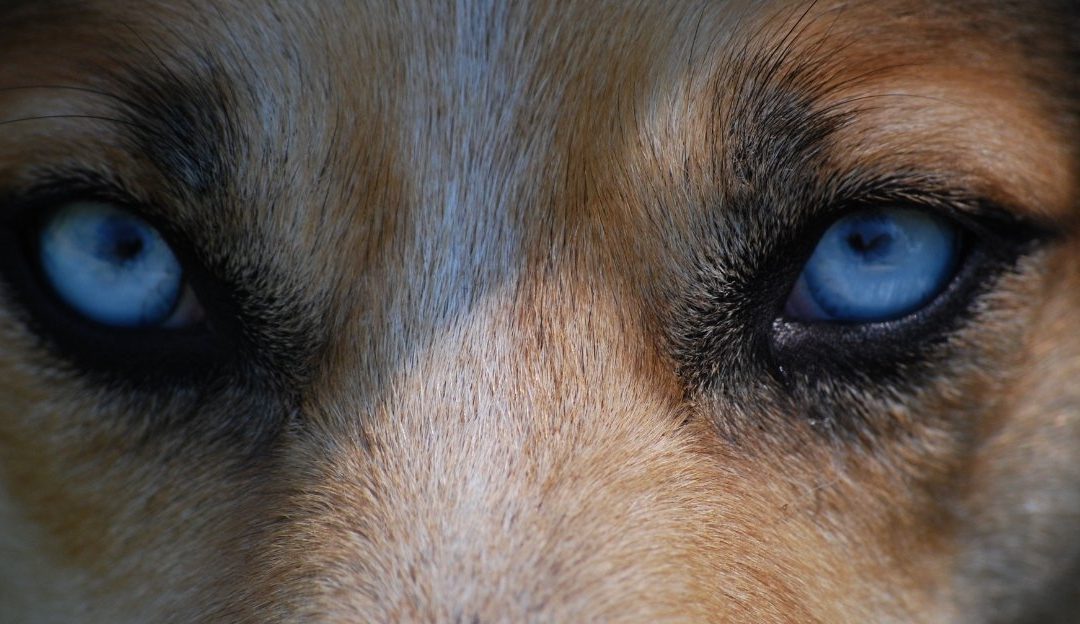
Vision Is Not in the Eyes, but in the Brain’s Interpretation of the Information It Receives
Canine Vision and the Brain’s Interpretation of Reality
In previous articles, we explored homeostasis and behavior as the organism’s attempt to maintain internal balance within the surrounding world. We also discussed behavior as the product of experience, environment, and the way the nervous system processes information arriving from the outside world. Over the coming weeks, we will explore the senses and the ways dogs perceive their reality. The logical place to begin involves vision.
However, the more we study canine biology and the nervous system, the clearer it becomes that vision has surprisingly little to do with the eyes themselves. In fact, most of what we call seeing happens only after visual information leaves the eye and reaches the brain.

Does a dog truly see the world as it exists, or does it see the world as its nervous system interprets it? Most people assume vision represents a simple process. We open our eyes, look around, and see what stands in front of us.
Biology tells a very different story. Throughout evolution, the eye did not evolve to reveal absolute truth. Its purpose never focused on producing a perfect image of reality. Its function was far more practical: the eye evolved to increase the chances of survival. Nature did not create the best possible camera; instead, it created a system that works well enough to keep the organism alive. Consequently, dogs do not see the world exactly as it exists. They see the world in the way their nervous system needs to perceive it in order to function successfully.
The Physiology of the Eye and the Evolutionary Importance of Motion Detection
This process becomes even more fascinating when we look at the physiology of a dog’s eyes. Dogs possess far more rods than humans. Rods represent photoreceptor cells specialized for detecting movement and functioning in low-light conditions. Because of them, dogs notice motion and navigate at dusk or during the night significantly better.
Humans, on the other hand, possess more cones—the cells responsible for color discrimination and fine visual detail. As a result, humans perceive a richer spectrum of colors, while dogs excel at detecting movement. If a completely motionless object stood far away, a human might notice it before a dog. But the moment that object moved even slightly, the situation would quickly reverse.
Sasha Riess Academy: A Professional Life on the Path to Spiritual Freedom
First Heat in Dogs: Does a Dog Feel Pain?
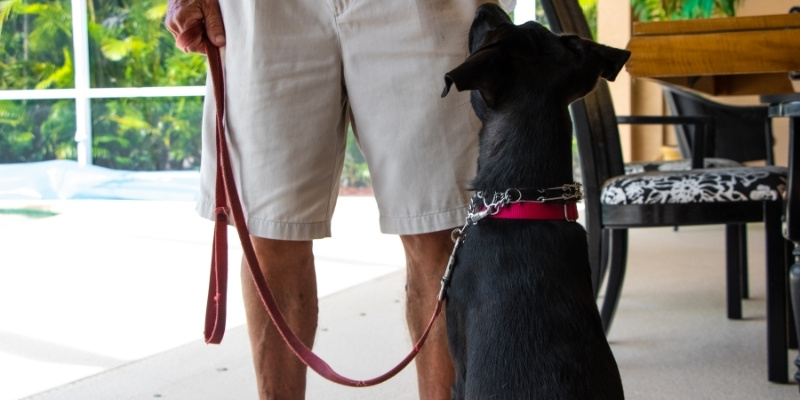
DOGS ARE CONSTANT OBSERVERS, LEARNING FROM OUR EVERYDAY RITUALS AND MOVEMENT.
Dogs evolved in an environment where survival often depended on detecting movement as early as possible. Therefore, the question of which colors dogs see matters far less than many people imagine. Today, we know that dogs do not see in black and white. They perceive colors, but within a much narrower spectrum than humans. Red and green do not appear the way they do to us.
However, when trying to understand canine behavior, color itself rarely determines a response. The nervous system focuses far more on the meaning of information than on its aesthetic qualities. A dog does not react because something appears red or green. It reacts because its nervous system has determined that the stimulus holds significance for safety, survival, or maintaining internal balance.
Why Canine Vision Challenges Breed Stereotypes
Perhaps this insight brings us to one of the greatest misconceptions in modern cynology. For decades, people have attempted to explain canine behavior primarily through breed. The moment we see a particular breed, we tend to assume how that dog thinks, reacts, and experiences the world.
Yet, when we examine how canine vision actually functions, this assumption quickly conflicts with biology. Whether we observe a Maltese, Border Collie, German Shepherd, Rottweiler, or Great Dane, the fundamental principles of vision remain remarkably similar. Evolution did not create a separate eye for every breed; it created the universal eye of the dog.
Most breed differences remain external. The internal mechanisms through which the nervous system gathers and processes visual information have remained largely unchanged. That is why two dogs can witness exactly the same event and respond completely differently, while two dogs of entirely different breeds may respond almost identically.
The explanation is not found in a dog’s eyes; it is found in the brain. The eyes act merely as the entrance through which information enters the organism. Only after that information reaches the brain does true interpretation begin. This is where perception emerges, where meaning takes shape, and where the organism decides whether what it sees remains safe, dangerous, interesting, or completely irrelevant. Therefore, dogs do not truly see with their eyes alone—they see with their nervous system.
Latent Learning and the Story of Shared Evolution
The distinction between looking and perceiving explains why we cannot understand canine behavior without understanding experience. Throughout life, the nervous system continuously gathers information and gradually builds an internal map of reality. That map allows the organism to predict events and make decisions that increase the chances of survival.
Importantly, the brain builds this map not solely through direct experience. One of the most fascinating concepts in learning biology involves latent learning. Latent learning represents the ability to learn simply by observing, even when no immediate need exists to apply the knowledge. In other words, a dog does not always have to experience something personally to learn from it; sometimes it simply watches.
This ability represents one of the most important outcomes of thousands of years of shared evolution between humans and dogs. Dogs evolved not only to understand human signals, but also to become exceptional observers of human behavior. Their survival often depended less on what they observed in nature than on what they observed in people. Humans became one of their most valuable sources of information about the world. By watching us, dogs learned to assess danger, safety, group belonging, access to resources, and countless other factors essential for survival.
Silent Observers of Our Everyday Rituals
Perhaps that is why owners often underestimate just how closely their dogs observe them. Many people believe dogs learn only during formal training sessions. In reality, dogs continue learning even when no one actively teaches them. They observe how we speak to family members, watch our conflicts, notice our daily routines, monitor how we respond to stress, and observe how we greet visitors. For the nervous system, each of these moments provides valuable information about how the surrounding world functions.
Every observation becomes another piece of the internal map the organism later uses when making important decisions. Simultaneously, a dog’s world changes not only when the physical environment changes. Very often, it changes when the human changes. When an owner changes beliefs, emotional responses, or communication patterns, the dog’s nervous system may interpret this as an entirely new world. Yesterday’s predictable rules no longer apply, behavioral patterns shift, and relationships within the family evolve. The dog is not responding to a new training technique or command; it is responding to a new reality it tries to understand.
Meaning Is Created in the Brain, Not the Eyes
Vision represents much more than a simple sense. It is not merely a window through which a dog passively observes the world, but one of the primary ways the organism actively constructs its internal reality. Every person it sees, every movement it detects, every interaction it witnesses, and every event it experiences becomes part of an intricate information system that helps determine what is safe, what is dangerous, and how to respond.
Dogs do not react to the world as it objectively exists; they react to the world as their visual system and nervous system interpret it. Perhaps the greatest misconception involves believing that vision begins in a dog’s eyes. In reality, understanding vision begins in the brain. Once we begin looking at dogs from that perspective, we easily understand why two dogs can observe the very same world while living in two completely different realities.
A Small Exercise in Human Perception

Look carefully at the following sentence. Imagine someone wrote it in the cuneiform script of ancient Mesopotamia. Now pause for a moment and ask yourself a few simple questions. What does it say? Is the message friendly or threatening? Does it warn of danger? Is it an invitation, a command, or a declaration of love?
Most readers would not know the answer to any of these questions. The reason is not that your eyes failed to see the symbols. Your eyes detected them perfectly; light reached your retina, and neural impulses traveled successfully to your brain. The difficulty arose afterward: your brain simply did not know what to do with the information it received.
In other words, you saw the message, but you could not assign meaning to it. Without meaning, there can be no appropriate biological response. Now imagine I told you the translation reads: „May the gods protect this home and everyone who lives within it.“ Suddenly, the very same symbols carry an entirely different meaning. The text has not changed, and the information has not changed. Only your understanding has changed.
This is precisely how perception and vision function in a dog’s eyes and brain. Simply because a dog sees something does not mean it understands it as we do. Likewise, just because we do not understand how a dog experiences a particular scene does not mean that scene holds no profound significance within the dog’s world. The nervous system never responds merely to what a dog’s eyes detect—it always responds to the meaning the brain assigns to what is seen.
Thank you for reading.
To discover more about how emotional alignment, balanced lifestyle, and authentic energy restore internal balance, read our canine communication guidelines.
See you next time.
At Sasha Riess, we look past commercial labels to honor the unique biological blueprint of your companion. True health requires addressing the subtle internal patterns that create lasting vitality and pureloveandharmony. Discover the customized path to your dog’s longevity: Linktree Sasha Riess
View this post on Instagram