

Seven years ago, I met a Husky who lived on the 23rd floor of a building in Miami. His owners had moved there from New York and, naturally, brought their dog with them, as he was already part of their family. However, shortly after arriving in Florida, they began hearing comments from people telling them that a Husky could not live in Miami, that it was too hot for him, that he was a snow dog, that he needed a large yard, and that living in an apartment was almost unnatural for a dog like him.
When you hear the same claim often enough, especially when people sound completely certain about what they are saying, you begin to question even what you previously believed. That is exactly what happened to them. They began seriously considering whether they should find a new home for their dog or even surrender him to a shelter. They were not considering this because they did not want him, but precisely because they loved him and believed that perhaps he needed something they could no longer provide.
The Problem Was Not Miami and Physical Endurance Myth
When we began working together, it quickly became clear that the problem was not Miami, the 23rd floor, or the fact that there was no snow outside the building. The problem was that the owners, like a huge number of people, had accepted a very widespread idea: a Husky must be tired in order to be calm.

If he is restless, he needs more walks. If a long walk is not enough, he needs to run. If he comes home and asks for activity again, the conclusion is that he has not expended enough energy. At first glance, this logic seems completely reasonable. Consequently, examining a husky in miami apartment scenario exposes how endlessly chasing physical exhaustion creates a conditioned athlete rather than a peaceful companion.
The more the dog runs, the more capable his body becomes of running even more. The more we try to exhaust him through physical activity, the more we build his fitness. A person can therefore spend months trying to tire out a dog while actually creating a more capable athlete every day.
When we look at sled dogs, it becomes clear how limited our human understanding of canine physical endurance can be. Conditioned Alaskan sled dogs can cover enormous distances for several days in a row. Studies have recorded dogs running around 160 kilometers per day for five consecutive days.
That is almost four marathons a day.
A human needs months of serious training to prepare their body for a single 42-kilometer marathon. Most people would not be able to run even one without preparation, let alone get up the next morning and do the same again. In certain working lines of dogs, we are talking about an entirely different level of metabolic and physiological adaptation.
When the Husky’s owners and I began thinking about this, a completely different question emerged. If a dog can become so physically capable, why would we expect to solve his internal state simply by physically tiring him out even more?
That gave all of us serious food for thought. Perhaps the goal is not to tire the dog out. Perhaps the goal should be to teach him that he does not have to be constantly in motion.
Neuroplasticity Changes the Entire Story
This brings us to neuroplasticity. A dog’s brain is not a static organ that is born finished and then simply controls the rest of the body. The nervous system changes through experience. What is repeated becomes more familiar, easier, and more efficient. Patterns that are used frequently become stronger.
If we create excitement every day, the dog becomes increasingly skilled at being excited. If every time he leaves the apartment means intense activity, the nervous system learns that going outside means an explosion of stimulation. If every time the dog is restless, we respond with even more activity, we unconsciously teach him that activation is a state that constantly leads to even more activation.
Therefore, neuroplasticity also works in the other direction.
A dog can learn calm. He can learn that every sound is not a signal to react, that every dog on the street is not an event that requires his response, that a leash does not have to mean the beginning of intense physical activity, and that it is completely normal to spend part of the day in a state of rest.
The Dog Adapts to the World We Give Him
The Husky on the 23rd floor did not stop being a Husky. He did not lose his genetics, origins, or physical predispositions. But his genetics were not a sentence saying that he could only be happy where there was snow and open space.
Dogs have an enormous ability to adapt to the environment in which they live. That is precisely why they can now live with humans in almost every part of the world. A dog can learn the rhythm of the city, the sounds of elevators, traffic, hallways, neighbors, walking schedules, and an entire set of rules that have almost nothing to do with the lives of his ancestors.
This does not mean that we should ignore his biological needs. Quite the opposite. But it means that we must distinguish a dog’s needs from our ideas about what a particular breed supposedly has to do.
Comfort bundle prebiotics and probiotic supplement gut health aid your dog’s immune and digestive systems
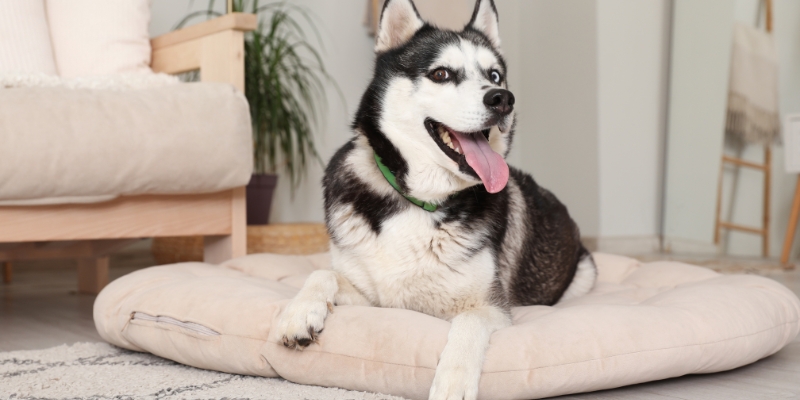
NEUROPLASTICITY ALLOWS A DOG TO LEARN CALM AND ADAPT TO ANY URBAN LIVING ENVIRONMENT.
An Apartment and a Yard Are Just Spaces
That is why the debate over whether a dog should live in an apartment or in a yard has become less and less interesting to me. A yard in itself is not quality of life. It is simply a space.
A dog can have a huge yard and spend every day looking at the same fence, the same tree, and the same gate. He can have a lot of square meters and very little actual life.
Simultaneously, another dog can live on the 23rd floor and have a rich, stable, and meaningful life with his people. He can have enough movement, exploration, contact, rest, sniffing, learning, and security. Square footage alone says nothing about the quality of his life.
The real question is not how much space the dog has. The real question is what his nervous system experiences and learns in that space every day.
Genetics Are Not a Command and Building a Happy Life
The same applies to genetics. The fact that a Husky carries predispositions for endurance does not mean that we have to create circumstances every day in which those predispositions are maximally activated. The fact that a Terrier has hunting tendencies does not mean that it is our obligation to create a hunting context every day. The fact that a herding dog has certain innate patterns does not mean that we must constantly encourage them.
One of our responsibilities in modern life with dogs is precisely to create conditions in which certain genetic predispositions do not have to remain constantly activated, while the dog’s basic needs are still met.
That is a much more mature approach to genetics than the simple idea that every breed must do every day “what it was created to do.”
The most important thing the owners of that Husky learned was not how to walk him more, how to entertain him more, or how to physically exhaust him. They learned to understand the dog they had in front of them. They learned to distinguish a need from a habit, genetics from destiny, and physical endurance from emotional stability.
Thanks to our work, the understanding they developed, and the guide that helped them apply what they were learning every day, the question of surrendering the dog to a shelter was never raised again.
Today, seven years later, that same Husky is still living his fantastic life in Florida, with his owners, on the 23rd floor.
He did not need a new home. His people needed a new understanding.
Nature gave the dog his genes. Life gave him an environment that is often very different from the world of his ancestors. Between the two lies his enormous ability to adapt.
Neuroplasticity.
Ultimately, our task is not to prove to the dog every day what he should be based on his breed. Our task is to give him the time, space, security, and experience to learn how to live where he is.
The Husky on the 23rd floor never had to go to Alaska to have a good life. He simply needed the opportunity to adapt to Miami, and his people needed the opportunity to finally understand him.
Thank you for reading.
To discover more about how emotional alignment, balanced lifestyle, and authentic energy restore internal balance, read our communication and behavior guidelines.
See you next time.
At Sasha Riess, we look past commercial labels to honor the unique biological blueprint of your companion. True health requires addressing the subtle internal patterns that create lasting vitality and pureloveandharmony. Discover the customized path to your dog’s longevity: Linktree Sasha Riess
What to Say When a Dog Is Dying: The Power of Letting Go and the Final Act of Love
View this post on Instagram