How fear and punishment shape a dog, what we can change, and what the real cost of our choices is. In the space of relationship that we build with dogs, punishment often appears as a simple tool, direct, fast, and visible. But beneath that surface, deep within the delicate layers of a dog’s body and soul, something far more profound is happening.
A change that begins as stress ends as cellular silence. The question is not only whether punishment “works”, but how it continues to live inside the dog, in his neurons, hormones, and emotional architecture. Through this story, I invite you to reflect with me, not as owners or trainers, but as human beings. Not about behavior as a problem, but behavior as a message. Because perhaps the dog is not the one who needs to be “fixed”, but the perspective through which we look at him.
How fear and punishment shape a dog: from momentary stress to cellular silence
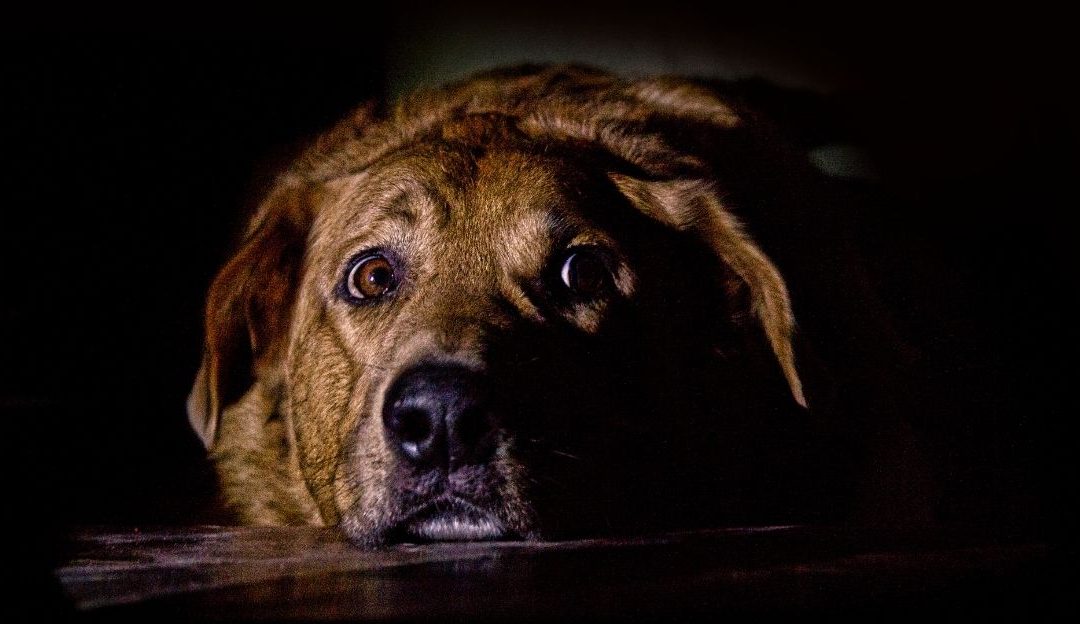
Punishment, regardless of its form, whether a raised voice or a physical correction, activates an immediate stress response in the dog’s body. Cortisol rises, the heart speeds up, muscles tighten. On the surface, behavior may appear corrected. The dog stops. Looks. Becomes silent.
But what is actually happening then? Epigenetics teaches us that stress is not just a temporary shadow, but a trace that remains, written into the way genes express themselves. Dogs exposed to frequent punishment show cellular changes that shape their resilience, emotional balance, and even their immune system. This is no longer a matter of training. This is a matter of existence.
How fear and punishment shape a dog and what we can change in our approach
Every dog carries his own inner world, a world of past experiences, inherited predispositions, and internal imbalances. When a dog reacts to punishment, he does not react from an empty space, but from a system that already exists. The behavior we see may be a reaction to the punishment, but also a reflection of what is already happening deep inside.
A dog that is often punished can develop chronic anxiety. His brain changes. Neurons in the amygdala begin to recognize threat where it may not even exist. And then come the reactions: withdrawal, “perfect obedience” that does not come from trust but from inner freezing. This leads us to the essential question: Where does behavior begin? In the reaction, or in the cell? Or perhaps in our gaze directed at the dog?
What can we change in our approach to avoid fear and punishment?
The real cost of our choices
A dog’s behavior is not just what he does. It is what his body is saying. When a dog barks, runs away, licks his paw, or drops his tail, he expresses an inner state, his own microcosm. Every cell in his body communicates in that moment through hormones and impulses. This reactivity is not “bad”. It is sacred. It is the body’s language saying, “I cannot integrate this.”
If a dog stops barking after punishment, we have not solved the problem. We have only switched off the signal. But the inner unrest remains. Cells remember. Does the external influence change the dog, or does his reaction shape his world?
In traditional teachings, an external stimulus creates a reaction. But in a dog’s life, the connection is more complex. Two dogs can experience the same punishment but react differently. One may freeze. Another may try to escape. A third may become aggressive. All of these reactions depend not only on the punishment, but on what already exists inside.
In the Pure Love and Harmony approach, we do not focus solely on what happened, but how it was experienced. Because influence does not exist without response. And every dog’s response is correct for him. Our task is not to shape him to fit us, but to understand the message revealed through him.
Fear as a frozen movement: the example of Little Albert
The famous Little Albert experiment from 1920 shows the power of fear. One loud noise paired with a white mouse changed the boy’s experience of the world. All white, soft objects became a threat. The same dynamic happens with dogs. Punishment does not remain confined to the moment. It expands. A dog does not learn what not to do. He begins to believe the entire world is dangerous. He is not becoming calm. He is shutting down.
What owners often perceive as “calm behavior” is actually a signal of cellular freezing. The dog is quiet, but not present. Obedient, but not free.
Behavior changed by fear: a price not seen right away
Punishment may bring short-term results, but long-term it creates internal fracture. Chronic stress affects the prefrontal cortex, the area responsible for learning, focus, and decision-making. The dog becomes insecure, withdrawn, and stops trusting. This behavior is not the problem. It is the message.
When the dog loses trust, we lose the relationship. And when the relationship is lost, we no longer speak the same language.
Chronic Stress in Dogs: Confusion, Illness, and Silent Signals
What is the real cost of our choices in the relationship with a dog?
How fear and punishment shape a dog and offer an opportunity for understanding
In every dog’s behavior there is an opportunity to learn something about him, but also about ourselves. His reactivity is a reflection of the relationship we build together. His silence may be our unconscious sharpness. His aggression may be our impatience. And this is not blame. It is an invitation.
If we view the dog as a system rather than an individual who must “behave”, we will see something new. We will see how the external world enters through his senses and shapes an inner landscape. That landscape shapes behavior. And our presence can be either light in that landscape or shadow.
There is another path
Instead of correcting behavior through punishment, we can support it through understanding. Through such an approach, the dog learns through safety. His body releases dopamine and serotonin, hormones of presence and joy. Cells begin to repair. Reactions calm down. Behavior changes naturally, not because it must, but because it finally can.
How fear and punishment shape a dog: a message for us and a lesson in togetherness
Dogs do not teach us through perfection. They teach us through authenticity. Their behavior is a mirror that does not lie. When we choose punishment, we choose control. When we choose understanding, we choose connection.
Let this text not be criticism, but invitation. To look again. To ask a different question. Not “How do I punish him so he listens?”, but “How do I understand him so he trusts me?” Within that question lies the entire transformation. Not only in the dog’s behavior, but in our own ability to be human, present, aware, and in service of life.
At Integrative and Holistic Grooming Education, we believe that silence is not always peace. We teach you to listen to what the dog’s body is saying when the voice is quiet. Explore our philosophy: Linktree Sasha Riess
👉 Follow our Facebook page and never miss our latest articles, news, and updates.
If you want your dog to eat healthy, natural food, try making homemade kibble. Here’s my recipe and personal experience — step by step.
Why I Started Making My Own Dog Kibble
For years, I searched for a way to provide my dog with healthy, nutritious food — especially when traveling. Commercial kibble is often full of additives and preservatives, so I decided to make it myself. The result amazed me — my dog eats with joy, and I know exactly what ingredients go into his bowl.
Preparing the Meat and Vegetables
2 kg (4.4 lb) organ meats 1 kg (2.2 lb) fruit 1 kg (2.2 lb) vegetables
I started with about two kilograms of organ meats, finely chopped and lightly sautéed. Then I added the rest of the meat and cooked everything together until tender. For vegetables and fruit, I used what I had on hand: apples (sweet and firm), zucchini, sweet potatoes, carrots, and regular potatoes. Once everything was cooked, I strained the broth and set it aside — that nutrient-rich soup can later be added to meals.
Blending and Shaping the Mixture
I placed the cooked meat and vegetables in a blender, added a little of the reserved broth, and two ice cubes. The ice helps create a smooth, creamy texture and makes blending easier — much like preparing hummus. I blended everything into a fine pâté. Next, I lined a baking tray with parchment paper, spread the mixture evenly, and smoothed it out with a spoon. I trimmed the excess paper to make it easier to remove the kibble later.
Drying in the Oven
This process is similar to industrial production — the kibble isn’t baked but dried. I set the oven to the lowest temperature and placed the tray inside. Drying takes about 3–4 hours (depending on the oven and whether you use a fan), but patience is key — slow drying removes moisture and gives the kibble the proper crunchy texture.
When the kibble was completely dry, I stored it in a glass jar with a lid. It can be kept in the refrigerator for up to one month, always ready to use — whether at home or on the road. My dog enjoys it just as much as freshly prepared meals.
Worth Every Minute
Making homemade dog kibble takes some time, but the result is worth every minute. I know exactly what my dog eats — only healthy, fresh ingredients with no chemicals or fillers. My advice to all dog owners: try it at least once. After that, it’s hard to go back to industrial food.
At Integrative and Holistic Grooming Education, we believe that food is medicine. By preparing your dog’s meals, you are not just feeding their body, but honoring their life. Explore our philosophy: Linktree Sasha Riess
You often hear the sentence: “My dog is on hypoallergenic food and everything is great.” And that can be true but only on the surface. The problem begins when hypoallergenic dog food is accepted as a permanent solution instead of temporary support. The goal is not for a dog to live with allergies forever.
What Is Hypoallergenic Dog Food Actually
Hypoallergenic food — most often hydrolyzed food — is industrially processed to such an extent that:
Proteins are broken down into amino acids.
The body no longer has to digest them, as the immune system does not recognize allergens.
Allergy symptoms disappear.
These processes are achieved through high pressure and extreme temperatures which break food down into its most basic components. The result is that the dog’s body can immediately use nutrients without effort, without reaction, and without inflammation. But that is not the same as healing.
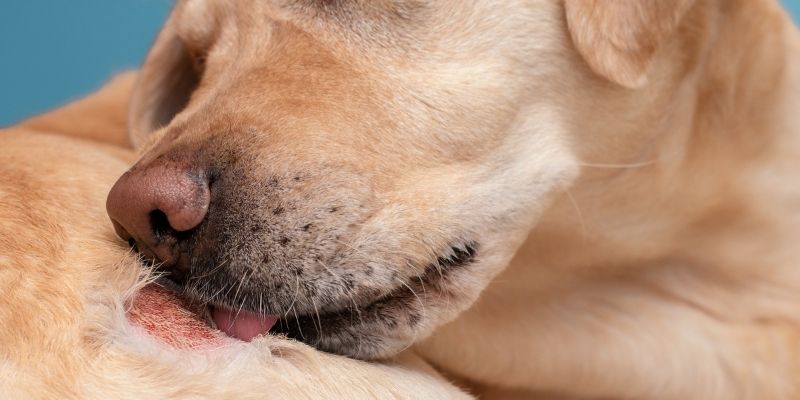
Skin symptoms are the most common sign of allergies in dogs.
Why Symptoms Disappear but the Problem Remains
Both humans and dogs need about 93 percent macronutrients daily, which include proteins, fats, and carbohydrates. Micronutrients, vitamins, and minerals make up a small percentage. Vitamins are largely produced by the body itself, similar to hormones, while minerals must be provided through food.
Hypoallergenic food allows the dog to function without reactions, but at the same time:
It does not strengthen the digestive system.
It does not restore the natural ability to digest food.
It does not train the body to process proteins.
In other words, the body adapts to avoidance instead of solving the problem.
When Hypoallergenic Food Makes Sense
Hypoallergenic food can be useful:
As a temporary recovery phase.
In acute conditions or after strong allergic reactions.
While the body stabilizes.
But if a dog stays on this type of diet for years, it often means we have stopped looking for the real cause. Allergy is not the enemy — it is a signal.
A Symptom Is Not the Same as a Solution
If a dog is “doing great” on hypoallergenic food, it means the trigger has been removed but not the reason why the body reacted in the first place. The long-term goal of caring for a dog is not permanent avoidance but understanding:
Why the digestive system is not functioning properly.
Why the immune system is overreacting.
How to gradually restore the ability to digest food.
Hypoallergenic food is not bad. But it is not a final solution either.
At Integrative and Holistic Grooming Education, we believe that true health starts from within. We teach you how to understand your dog’s signals and provide care that heals, not just masks. Explore our philosophy: Linktree Sasha Riess
In this story we explore how fear of life, trauma, and family order shape our decisions, through a moving story about Roberto and his dog. You will learn how painful partings can become lessons in acceptance and freedom.
When Parting With a Dog Becomes a Mirror of the Soul
After the previous column, most reactions came to the part about Roberto and his dog. Many asked, “How could he leave him” People wrote to me about their own painful separations from dogs. Some expressed anger, others felt touched by their own unresolved grief. Almost everyone wanted to know whether the decision was really his or whether he could have chosen differently. There were far more questions about the separation than about the sexual abuse the child endured in his family. And that is exactly why I want to stay with this topic. Because in that one scene, in which a boy cannot bear to look at his dog and decides to give him away, lies a mirror of much bigger questions, about free will, about destiny, about our tendency to judge, and about what it truly means to accept life. At first glance, Roberto “simply” made a choice. He had a dog, the dog made a mess in the house, and Roberto decided he could no longer look at him. He chose to take him away, and with that, he ended their relationship. But that is only the surface. Behind that choice stood an unbearable truth, the truth about the violence Roberto experienced from his father and grandfather.
The dog, through his act, became an unconscious witness to everything that could not be named in that family. His presence became a mirror that reflected what was forbidden to see. And suddenly, the boy could no longer endure it. The dog revealed the family secret through his body. And the child, powerless before that force, did the only thing he knew how to do, he ran away. And this brings us to the essence, did Roberto really choose
Free Will and the Order of Love
Free will is not what we imagine. We like to believe that our will is a sword that cuts through life and that we can direct everything by ourselves. But free will is only a thin veil. Behind that veil are forces we do not see. Family loyalties, inherited destinies, unspoken grief, suppressed fears. Our decisions are often not truly ours. They are movements of a system in which we are only one piece. Roberto could not have acted differently at that time. His action was the movement of a child’s soul trying to protect his mother from the father’s brutality. Trying to hide the shame and violence they lived with. Sacrificing himself to keep the family secret untouched. On the surface it looked like irresponsibility. In the depth it was a powerless sacrifice, an attempt to save what a child cannot control. It was the same movement that later pushed him into prostitution, alcoholism, and drug use, all in a paradoxical attempt to survive. Was it worth it It is easy to say, “A bad man. A coward. A traitor.” But what happens then Bert Hellinger once said: “Everything is in its place. For the creative force of life there is no better or worse. Everything serves something. And whenever we judge, we lose connection with this force. We become weak. Those who judge always end up alone. Because whoever stands next to someone who constantly judges soon withdraws. Judgment isolates. It impoverishes us, and every time we judge, something precious is lost forever.”
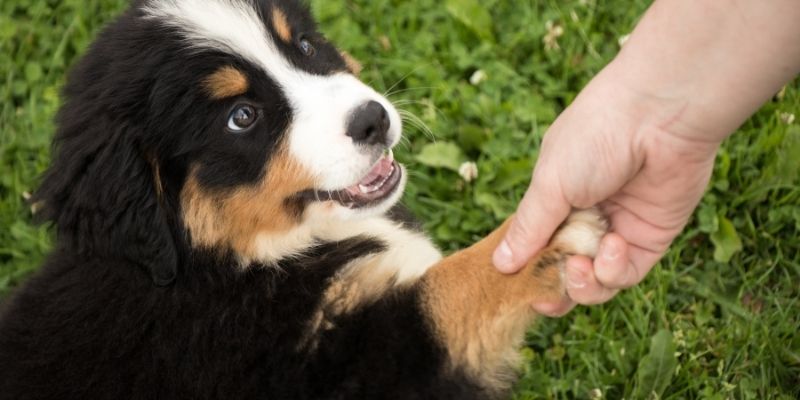
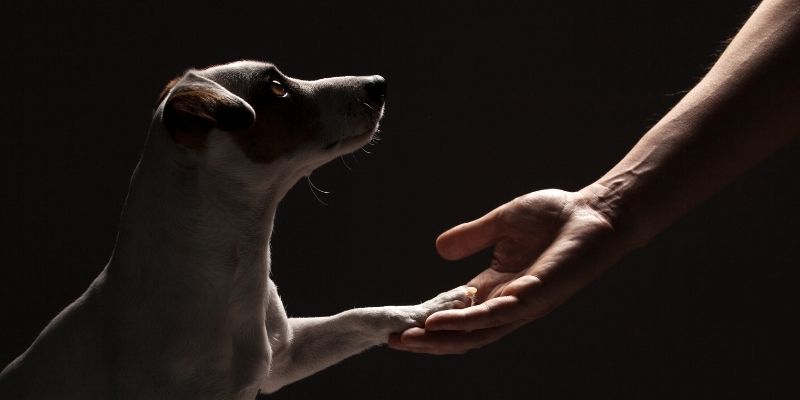
The touch of hand and paw – a moment where love transcends judgment.
The Dog’s Look Without Judgment
When we look at Roberto through judgment, we see only the act of leaving the dog. But we do not see the powerless child, the young man trying to hide the pain, or the adult who had to survive a burden greater than himself. And who eventually found his way back to himself, his heart, and his life. Judgment closes doors. Understanding opens them. What hurts us most in these stories is that dogs do not have a concept of betrayal. They do not understand our human constructs. When we leave them, they may look back once more. But in that look there is no judgment. There is only what is. It is a look that, paradoxically, frees us. It reminds us that there are relationships beyond judgment. That harmony can be found even through painful separation. When we judge Roberto, we see only the act of leaving the dog. But we do not see the child who was powerless, the young man who hid pain, the adult who survived what no child should, and the man who eventually returned to himself.
The River of Life, Acceptance of What Is
If we imagine life as a river, we believe we are standing on the shore choosing when to enter, where to swim, and where to leave. But in truth, we are already in the river. From birth we are in the river of life. The water carries us. It carries us to its mouth where we will look death in the eye. The river is sometimes calm, sometimes wild, sometimes pushes us into rocks. Our freedom is not in stopping the river or choosing its direction. Our freedom is in surrendering and saying yes to what is. Yes when it hurts. Yes when we do not understand. Yes when we wish life were different. That yes does not justify violence or erase pain. But it frees us from the illusion that we could have changed everything. It frees us from guilt and endless rethinking. No, it could not have been different. But yes, it can be different from now on. Free will means surrendering to the river of life and swimming with the support of all who belong to that river, all who came before us, all who were excluded, rejected, condemned, or forgotten.
The River of Life – flows without judgment, carrying us toward understanding and freedom.
When we recognize everything that was, and when we say yes to everything that was and everything that is, the door to tomorrow opens. We do not have to build what is already created. We only need to learn how to open our arms to life. Our partings with dogs are lessons about life. Some part with a dog because he gets lost. Some because circumstances pull them apart. Some because the dog leaves first. And some, like Roberto, because they can no longer bear what the dog reveals. In all these situations we feel pain and the question returns, did we really choose Or were we chosen by something larger Perhaps true freedom is not in choosing. Perhaps true freedom is in stopping judgment, both of ourselves and of others. To say, “That is how it was. At that moment it could not have been different.” And then the inner battle ends. The feeling of betrayal ends. Peace comes. The look of a dog, even when we leave him, may be the greatest gift he leaves us. Because in that look there is no judgment. No contempt. No label. Only life moving forward.
Perhaps that look reminds us of what we ourselves must learn, that life is not about judging, but about accepting. That love is not always beautiful and easy, but often painful and paradoxical. And that we stop being lonely only when we stop judging. Only when we stop running from life. Only when we say yes to life as a whole and open ourselves to a future we could not imagine. Roberto did not “just” leave a dog. He was pulled by forces larger than him, part of a wider family system. His act was painful, but it revealed truth. And it left us with a question, how much of our decision making is truly ours Dogs remind us of what exists beyond judgment. They return us to connection with life, even through separation. And perhaps right there, in the moment we stop judging and say yes, true freedom begins.
At Integrative and Holistic Grooming Education, we believe that communication is felt, not forced. We teach you how to listen to your dog’s soul instead of just commanding their body. Explore our philosophy:Linktree Sasha Riess
Many owners believe every dog must love walks. But the truth is, some dogs experience walks as stress — not pleasure. When a dog reacts intensely outside, it doesn’t always mean disobedience — it might be a reflection of your own emotional tension.
Don’t Force Walks If Your Dog Doesn’t Want Them
One owner shared: “We’ve had one dog for five years, and the other has been with us for five months. Every walk with him feels like a risk.” There is no such thing as a “pleasant walk” with a dog that doesn’t want to walk — it’s like forcing someone having a seizure to dance.
For such dogs, walking is not enjoyment but stress. Everything around them is overstimulating: other animals, people, smells, sounds, interactions. When a stimulus activates, the dog reacts. There’s already a fixed neural pathway between an external trigger and the central nervous system’s response. In that moment, you can’t bypass the reaction. If you expose the dog to triggers, he will simply — react. That’s when you need to withdraw, return home, and work on removing the cause — not “fixing” the dog.
Is Your Dog Too Attached to You — or Are You to Him?
Many owners say, “My dog is too attached to me.” But the real question is — is he too attached to you, or are you too attached to him? Pause and ask yourself honestly: Do you allow your dog to be a dog — a free being with emotions and boundaries? Or is he your support, the one who fills the emptiness you carry inside?
Excessive emotional entanglement often creates stress for the dog, even though it may look like love.
Emotional Attachment Isn’t Love
In The Alchemist of the Perfect Relationship, it says: “I wanted my dog to look at me the way I wanted my parents to look at me.” That’s what many people unconsciously do — through their dog, they seek the gaze, understanding, attention, and love they never received. And they hope that if they love their dog enough, someone else will finally see them. But real love for a dog doesn’t come from need. It comes from freedom.
Looking for the Cause Within
None of this is about guilt — it’s an invitation to awareness. When you start looking for the causes of your dog’s behavior within yourself rather than in him — that’s when true growth begins. Your dog isn’t “attached to you” as much as you are attached to what you’re experiencing through him. You might be doing everything “right,” yet something still doesn’t feel aligned — that’s a sign you’re emotionally entangled. That’s not love — it’s a bond that suffocates both of you. Only when you let go — when you allow your dog to simply be a dog — the relationship becomes healing and free.
At Integrative and Holistic Grooming Education, we believe that communication is felt, not forced. We teach you how to listen to your dog’s soul instead of just commanding their body. Explore our philosophy: Linktree Sasha Riess