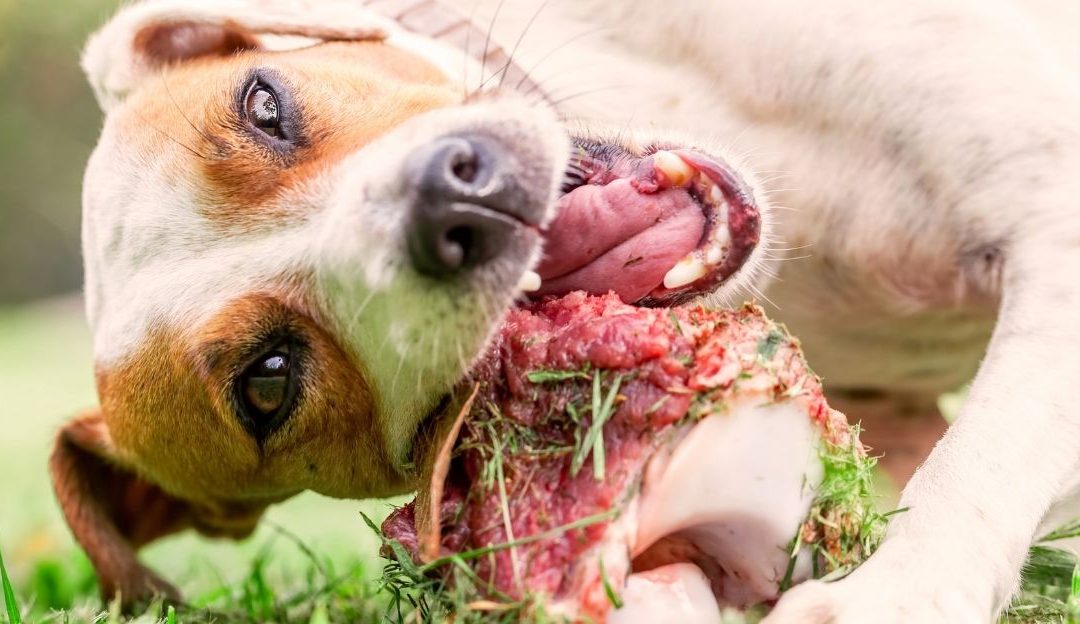
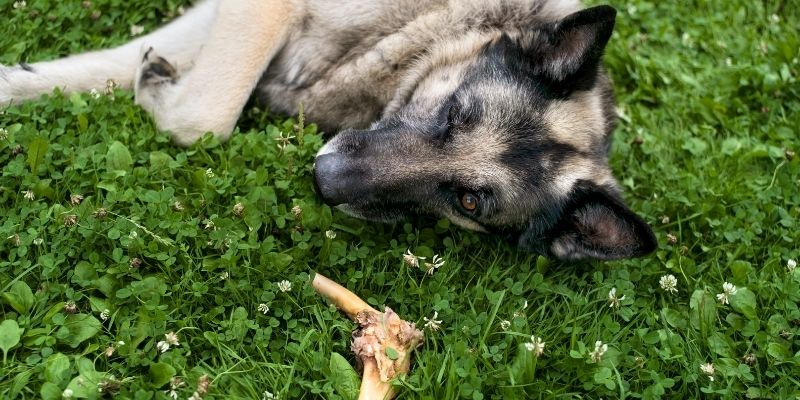
Raw bones can be extremely beneficial for dogs because they strengthen teeth, provide minerals, and satisfy the natural need for chewing. However, there is one important detail many owners overlook: raw bones that sit for too long become dangerous. In a healthy human dog relationship, understanding these subtle biological shifts is what keeps our companions safe.
Why Old Raw Bones Become Risky
If a bone remains for several days in the bowl, the yard, or even in the freezer, a sticky film begins to form on its surface. This is a sign of decomposing connective tissue and fat. At that moment, the dog no longer chews the bone slowly but may swallow it whole. This is when the greatest risk occurs.
The danger includes:
Choking or the bone getting stuck in the throat.
Potential injury to the esophagus.
Risk of sharp fragments becoming lodged in the intestines.
Therefore, an old raw bone is no longer safe for the human dog relationship to endure.
Which Bone Is the Safest?
The best choice will always be a completely fresh raw bone that is chilled or frozen, but not one that has been stored for weeks. When fresh, the dog can chew it normally, grind it slowly, and digest it without significant risk. Fresh bones provide high amounts of natural minerals that simply cannot be obtained from industrial dog food.
Old bones decompose and can cause choking or severe internal injuries.
What About Cooked Bones?
This is a rule every dog owner must know: Never give a dog cooked bones.
Cooked bones break into sharp, brittle fragments that can tear the intestines, cause severe constipation, and lead to internal damage and painful blockages. If you cook bones to make broth, gelatin, or nutritional additions to meals, that is an excellent choice—but only the liquid nutrients should be shared. The cooked bone itself should never be fed to a dog.
Raw bones are an excellent and completely natural source of minerals, but only when they are given fresh and in the proper form. In the human dog relationship, providing the right tools for health is an act of love.
At Integrative and Holistic Grooming Education, we believe that precision in nutrition is a reflection of our care. When we measure with love, we feed the soul. Explore our philosophy: Linktree Sasha Riess
Punishing a dog is never the solution. It leaves lasting consequences not only for the dog but also for us. Instead of control and force, the real path leads through love, understanding, and trust. Our approach to discipline is perhaps the most profound reflection of the human dog relationship.
My View on Canine Behavior
Today I live with a dog who behaves beautifully. He follows me, listens, and walks at my side. At first glance, it looks perfect, but I always ask myself one question: At what cost?
When a dog’s behavior comes solely from our will and pressure, that behavior is no longer natural, but imposed. Such an approach leaves deep traces, and the consequences often show up later as various health problems. We are seeing more and more dogs suffering from epilepsy, tumors, and other serious diseases. While many search for the cause in poor nutrition or vaccinations, few stop to ask whether these physiological factors are the only explanation. Could the suppression of a dog’s soul within the human dog relationship be the silent trigger for physical decay?
A Harmonious Relationship Between Owner and Dog
Punishing a dog does not create obedience; it creates a „Janissary“—a being stripped of its own will. Love and understanding are the only materials that can build a real, lasting relationship.
Punishing a dog does not lead to obedience — love and understanding build a true relationship.
The Question I Ask Myself
When I am faced with a choice in how to respond to my dog, I always remember one thing: Every time I punish him, I am actually punishing myself.
Our choices in how we treat our dogs mirror our inner world. If I choose the path of strict control and force, it means I carry inner insecurities that I project onto him. The human dog relationship acts as a mirror, showing us the parts of ourselves we are afraid to face.
Why This Is Not Easy to Accept
It may sound simple: Do not punish your dog, love him, and let him be who he is.
But if it were easy, people would effortlessly give up bad habits, stop eating food that harms them, or leave toxic environments. Life would be much simpler. In reality, it takes courage and deep honesty to admit that the way we treat our dog is a reflection of how we treat ourselves. True healing begins when we stop seeking control and start seeking connection.
At Integrative and Holistic Grooming Education, we believe that precision in nutrition is a reflection of our care. When we measure with love, we feed the soul. Explore our philosophy: Linktree Sasha Riess
Natural healing is about returning to the roots of care. This approach follows Dr. Hulda Clark’s well-known natural parasite cleanse, successfully used for both people and pets. The combination of walnut tincture, parsley tea, wormwood, and clove helps remove parasites while strengthening your dog’s digestive system and the human dog relationship through mindful, proactive care.
How to Make Walnut Tincture
Preparation: Wash young black walnuts (still in their green husks) under cold running water, scrubbing gently with a brush if needed.
Boiling: Place them in a pot and pour in enough cold water to cover the walnuts completely. Bring to a boil.
The Secret Ingredient: Once the water starts boiling, add 1/8 teaspoon of vitamin C crystals or powder. Cover with a lid and do not remove it. Let it sit for 24 hours.
Finalizing: After a full day, remove and discard the walnuts. Add another 1/8 teaspoon of vitamin C to the liquid and let it stand for another day.
Storage: Store the finished tincture in a clean glass bottle with a tight lid. Keep only a two-day supply in the refrigerator and freeze the rest for later use.
Parsley Tea for Dogs – Support During Cleanse
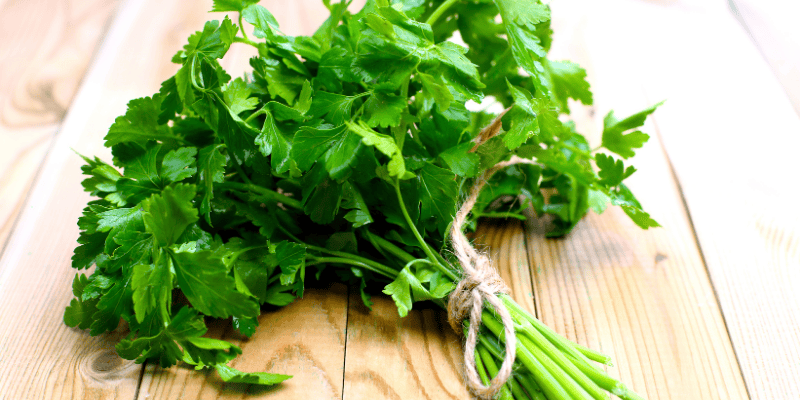
Parsley tea supports the kidneys and helps the body flush out toxins, making it a great natural addition to your dog’s parasite-cleansing routine. Add two bunches of fresh parsley to half a liter of water and bring to a boil for about three minutes.
The 4-Week Cleansing Protocol:
Week 1: Give your dog 1 tablespoon of parsley tea per 11 lbs (5 kg) of body weight daily.
Week 2: Continue with the tea and add 1 drop of walnut tincture per 11 lbs (5 kg).
Week 3: Keep giving the tea and add a pinch of wormwood (about what fits between two fingers).
Week 4: Add a pinch of freshly ground clove.
Tip: Always grind cloves right before use—never ahead of time—to preserve their natural healing compounds.
Walnut Tincture for Humans
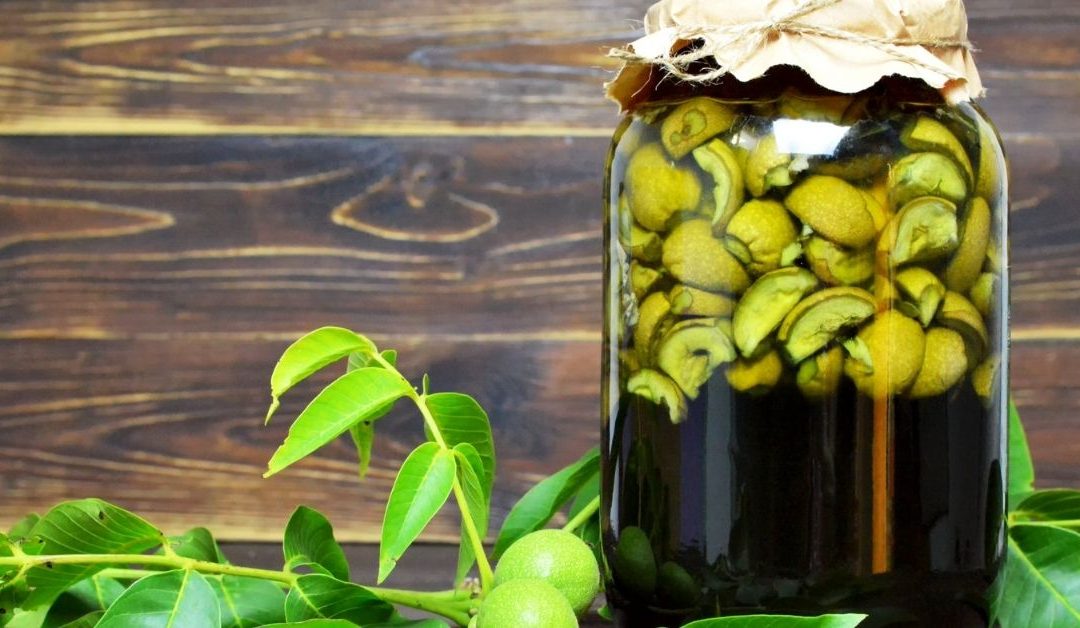
For your own personal use, place the green walnuts in a jar, cover them with vodka, and add 1/8 teaspoon of vitamin C. Before sealing, place a piece of cellophane between the jar and the lid. Let the mixture sit for three days before use.
Parsley tea for dogs is used for detoxification and kidney support, a natural pillar of canine health.
Natural Parasite Cleanse Protocol
By working on nutrition and restoring the natural balance, you help the body stop losing function and begin the process of healing. This protocol doesn’t just fight parasites; it reinforces the human dog relationship by acknowledging the dog as a biological being that deserves a clean, vibrant internal environment.
At Integrative and Holistic Grooming Education, we believe that precision in nutrition is a reflection of our care. When we measure with love, we feed the soul. Explore our philosophy: Linktree Sasha Riess
How often to bathe and brush dogs is a question every owner of a double-coated breed must master to ensure their pet’s health. Understanding how often to bathe and brush dogs correctly is not just an aesthetic ritual; it is a vital practice that directly affects the dog’s comfort, prevents pain during detangling, and helps effectively remove the undercoat. In many breeds, brushing a dry coat can be extremely painful, which is why your grooming routine must always combine proper bathing with brushing.
How Often to Bathe and Brush Dogs: Frequency Matters
The frequency of bathing depends on the environment in which the dog lives. A dog that stays in a clean home and does not sleep in the owner’s bed can usually be bathed once a week or every ten days. However, dogs that live in dirtier, urban environments or spend a lot of time outdoors may require more frequent bathing, every five to seven days. If the dog sleeps in the owner’s bed, many choose even more frequent bathing to maintain impeccable hygiene.
Why How Often to Bathe and Brush Dogs Is Vital for Double Coats
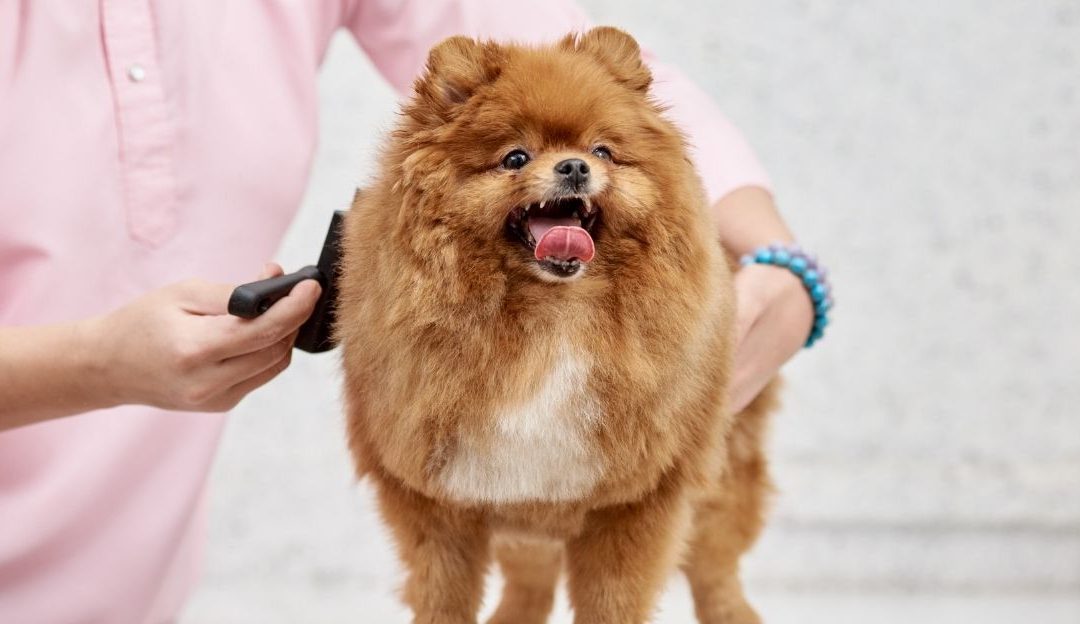
Breeds such as Pomeranians, Chow Chows, Keeshonds and Samoyeds have a dense undercoat that matts easily, especially when dry. Brushing without bathing often causes pain because the hair breaks, pulls and catches, and owners frequently make the mistake of brushing the dog “dry” thinking they are helping. Proper bathing with plenty of high quality conditioner allows the coat to glide under the brush and the undercoat to be removed easily.
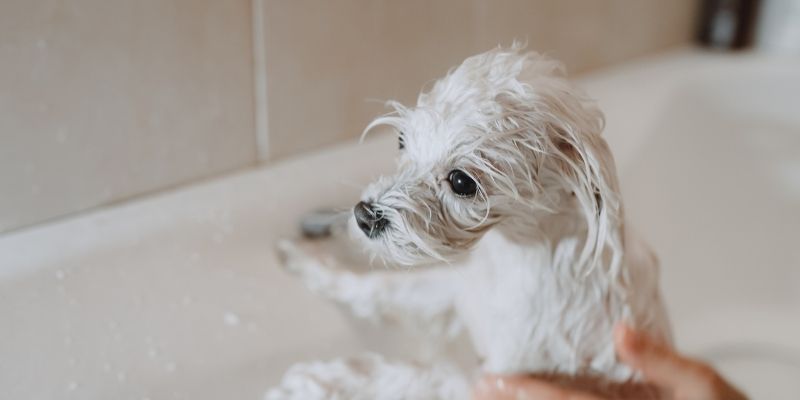
Proper bathing with shampoo and conditioner prevents painful hair pulling.
What Does a Proper Brushing Routine Look Like
Undercoat is removed with special brushes that do not hurt the dog when the coat is well prepared. After bathing, with the right shampoo and conditioner, the coat separates more easily and the process becomes much more pleasant. Professionals in grooming academies teach students this skill first, how to hold the brush correctly, how to work in sections, and how to assess the condition of the coat before starting. If you are unsure how to brush your dog properly, it is best to do it after a bath or consult a groomer.
Why You Should Never Brush a Completely Dry Coat
Dry hair breaks easily, the skin becomes tight and every stroke of the brush can cause pain, especially in breeds with long or double coats. This is the main reason why many dogs run away from the brush, not because they dislike grooming, but because it hurts. Bathing and proper conditioning make an enormous difference and make the entire process much easier for both the dog and the owner.
At Integrative and Holistic Grooming Education, we believe that grooming is a conversation of touch. By choosing the right method, you turn a chore into a moment of pure bonding. Explore our philosophy: Linktree Sasha Riess
During the show “1000 Why – 4 Therefore,” a question was raised about a dog with spots on its pupils. The veterinarian explained that cataracts can develop in later years. The owner wanted to try a treatment with cold-pressed castor oil, one drop each evening. Many owners have reported the same issue: their dogs suddenly lost sight or experienced a gradual decline in vision. Such problems are often not purely ophthalmological but also immunological and metabolic. Understanding the human dog relationship and its impact on health is the first step toward healing.
The Eyes Reflect Inner Health
Just as the eyes can be affected by diabetes, visual degeneration in dogs indicates a deeper imbalance in the body. The eye is difficult to regenerate, but it’s not impossible to stop degeneration. The goal is not to “fix the eye” but to stop the process that breaks it down.
We return to the relationship with the dog, reducing stress, and applying the principles of holistic care. Stress is one of the main triggers of diabetes and autoimmune diseases. It disrupts mineral balance and weakens the microbiome, which is the foundation of immunity. Poor nutrition—too many carbohydrates and sugars, and too few proteins—further worsens the condition. In this process, the adrenal, thyroid, and parathyroid glands are often affected, leading to increased acidity in the body and a range of symptoms, including eye problems.
Castor Oil and Alternative Approaches
Experiences with castor oil vary, and there is no universal solution. Before treating the symptom (the eyes), it is important to understand the cause, because loss of vision is only a signal of a deeper problem within the dog’s body.
The eyes are part of a complex system, and if your dog has vision problems, ask yourself:
What is my dog trying to show me through this symptom?
Why does my dog not “see”? What in our human dog relationship or environment remains unseen?
By working on nutrition, reducing stress, and restoring emotional balance, you help the body stop losing function and begin the process of healing.
Trust and closeness — the foundation of a dog’s health and emotional balance.
Eye Health Diet for Dogs
This diet is designed to strengthen the immune system, support eye health, and balance the dog’s body through natural ingredients.
Ingredients
450 g lean ground beef
85 g beef liver, chopped or ground
115 g beef heart, chopped or ground
170 g spinach
85 g carrot, chopped or ground
3 eggs (without shells)
55 g mussels (well rinsed; canned is acceptable)
1 pear
3 teaspoons finely ground almonds
3 teaspoons finely chopped mint
55 g sardines in water (added at mealtime)
1 flat teaspoon kelp powder (added at the end)
Note: Give eggshells only to puppies, not to adult dogs.
Preparation
Grind and mix all ingredients into a uniform mixture.
Cooking methods:
In the oven at 160°C for 30–45 minutes.
In a slow cooker on low for 4–6 hours.
After cooking, let it cool completely. Add powdered supplements (like kelp) only after the mixture has cooled. If using capsule supplements, open them and mix the contents evenly into the food. Grind nuts and seeds before adding them. Freeze portions you won’t use within 72 hours. Frozen food retains nutritional value for up to 3 months.
Daily feeding amount: about 3% of your dog’s ideal body weight.
Important Note
Avoid fish oils as a source of omega-3 fatty acids because toxins from polluted waters remain in the fatty tissues of fish. Instead, use flaxseed oil or pumpkin seed oil, added just before serving.
In Conclusion
Eye health does not depend solely on local treatments but on the overall balance of the body. Proper nutrition, stress reduction, and emotional stability can help slow down or stop the degenerative process. When your dog begins to see clearly again, it’s a sign that there is more light and balance in your human dog relationship too.
At Integrative and Holistic Grooming Education, we believe that precision in nutrition is a reflection of our care. When we measure with love, we feed the soul. Explore our philosophy: Linktree Sasha Riess
Giardia (Giardia lamblia) can seriously impact a dog’s gut health and immune system. While it is a persistent parasite, a supportive natural remedy for giardia in dogs can help strengthen the microbiome and aid the body in fighting the infection. This recipe is simple to prepare at home and completely safe for your companion.
How to Make the Natural Giardia Remedy
The base of this remedy is fresh buttermilk, which provides essential probiotics.
Prepare the Buttermilk: Pour 1 liter (about 4 cups) of unsweetened cooking cream into a blender and blend until it turns into a buttery consistency.
Separate: Transfer the butter into a strainer, drain the excess liquid into a bowl, and rinse the butter under cold water.
The Result: The remaining liquid is your fresh buttermilk. If you don’t have enough, you can substitute it with high-quality kefir.
Preparing the Herbal Ingredients
Herbs like marjoram and oregano are nature’s answer to parasites. In a mortar, place 4 tablespoons each of the following:
Marjoram
Thyme
Oregano (fresh if possible)
Dill
Gently crush them to release their natural aroma and potent nutrients.
Combining and Storing the Mixture
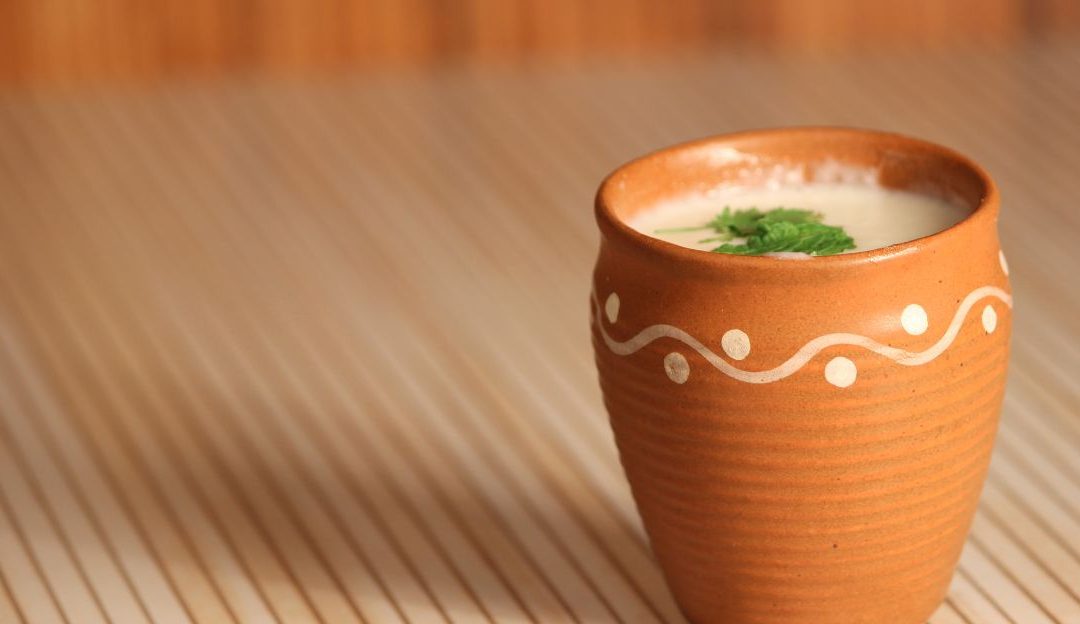
Add all the crushed herbs into a glass jar with half a liter (2 cups) of your homemade buttermilk or kefir. Mix well, close the lid, and store it in the refrigerator for 24 hours. This allows the herbal properties to fully infuse into the liquid
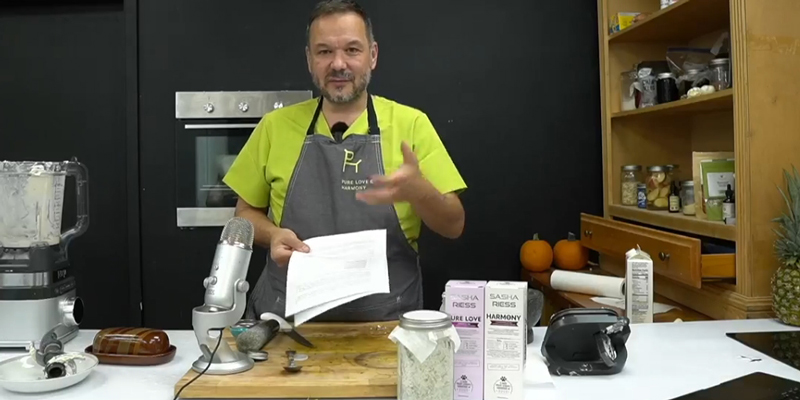
Sasha Riess demonstrates how to prepare a natural supportive remedy for giardia in dogs.
Dosage and Use
To get the most out of this natural remedy for giardia in dogs, follow this specific protocol:
Days 1 & 2: The dog should fast. Only bone broth is given to rest the digestive system.
Day 3: Give 1 tablespoon of the mixture per 22 lbs (10 kg) of body weight, four times a day.
Days 4–7: Feed a light diet (like the carrot soup and rice mentioned in our previous guides).
The Follow-up: Continue providing buttermilk or kefir for another 6 to 8 weeks to fully restore gut flora.
This preparation helps reduce the number of parasites, supports gut flora, and improves digestion during recovery and detoxification.
At Integrative and Holistic Grooming Education, we believe that precision in nutrition is a reflection of our care. When we measure with love, we feed the soul. Explore our philosophy: Linktree Sasha Riess
The Janissary Dog: Sorrow and the Absence of Instinct in the Modern Human Dog Relationship
There is a phenomenon rarely spoken about, something we have done slowly, quietly, and almost imperceptibly across generations, as if it were a natural process. Dogs as a mirror of society. We speak about dogs, our most loyal companions, but not in the romantic sense we are used to. We speak about how we turned one of humanity’s oldest allies into our own janissaries. Not in the historical military sense, but in a symbolic, psychological, and systemic one.
Deformation of the Human Dog Relationship: The Loss of Role and Original Nature
We created beings separated from their origin, from their inner order, from their primal nature, and reshaped them to serve our needs, our projections, and our wounds. We did this under the disguise of care, safety, love, and modern civilization. The result was not harmony, but a deep deformation of the relationship between human and dog.
Loss of Role, Loss of Health
When I observe a dog in the modern urban environment, I often ask myself how much of it is still a dog, and how much has become a product of our neuroses, fears, inner emptiness, and unfulfilled needs. Historically, janissaries were children taken from their families, torn from their origin, religion, and culture, then reeducated to completely forget who they were before becoming instruments of another will. When applied to dogs, the same pattern emerges.
We took away their instinct. We took away their right to movement. We took away the role that defined them for millennia as beings maintaining balance in nature. Their original purpose was clear. To guard territory. To inform the pack. To maintain the rhythm of village life. To hunt. To herd. To accompany humans as partners in the real world, not in a simulation of life.
In the modern human dog relationship, the dog has lost its purpose. Not because nature demanded it, but because we assigned a new purpose that serves our emotional deficits. Today, the dog exists to fill what we fail to fill in human relationships. To be therapy. To be an emotional prosthesis. To be a living cushion for comfort, a living charger for belonging, a living neutralizer of loneliness, frustration, and inadequacy. In this process, the dog disappears and only a function remains. The original identity is lost, and what emerges is what we metaphorically call a janissary.
The Price Paid: The Janissary as a Psychological Pattern
The most painful part is that most people believe they are helping the dog. The truth is far darker. A dog that is no longer allowed to move freely and be a dog will not develop emotional or physical stability. It becomes frustrated, tense, energetically overloaded, and neurologically imbalanced. This is a dog no longer living from the inner order of nature, but reacting impulsively to the environment imposed upon it.
It is a dog born and raised without understanding its own role. A dog that spends most of its life waiting for a human to explain what is allowed and what is forbidden. A dog that does not govern its body, but oscillates between shutdown and explosion. A dog that no longer knows how to be a dog, but knows how to react to human emotional disturbances. A dog that guards the human instead of guarding space. A dog that reacts to trauma instead of choosing function.
A Mirror of Human Nature
In Chinese medicine it is said that whoever loses their role loses their health. This applies to humans and animals alike. When we take away a dog’s role, we remove part of the inner order from which vitality flows. The result is a dog in constant energetic conflict. A dog that ignites easily, collapses easily, withdraws easily, and becomes reactive. A dog that is simultaneously too much and too little. Too much energy without structure and too little safety without stability. This is the psychological pattern of the janissary. A being removed from its source and placed into an unnatural relational matrix, where it learns to live for another’s will and stability.
In trying to protect dogs from the world, we protect them from themselves. We have normalized extreme control.
Fear of Instinct: Sterilization as Systemic Control
As a society, we have normalized extreme control. Collars. Leashes. Restricted movement. Prohibited socialization. Banned instinctive behavior. Banned barking. Banned courting. Banned territorial marking. All justified as being for the dog’s own good. It seems we fear allowing the dog to be what it is. Like a parent too afraid to let a child fall, holding them so tightly they never learn to walk.
In trying to protect dogs from the world, we protect them from themselves. We create generations of dogs who never learn stability because they never experience their own motor intelligence, territoriality, and energetic boundaries.
These processes are not accidental. They reflect our relationship with our own instincts. As we treat dogs, so we treat our own nature. People afraid of their inner strength fear the dog’s strength. People afraid of emotional freedom fear canine freedom. Those who have not integrated their inner wolf cannot allow their dog to remain a descendant of wolves.
Such a human reshapes the dog into a pleasant, obedient, functional janissary who emits what the human cannot feel. The dog becomes an emotional filter and absorber, carrying tensions, sorrows, fears, and guilt that are not its own.
Another form of systemic manipulation appears in the idea of sterilization as a universal solution. Behind the mask of humane population control lies a deeper dynamic. When we say the only solution is removing a dog’s sexuality, we prefer a dog weakened along its vital axis. A dog without hormones is a dog without part of its life force. Like a janissary severed from origin, the dog is cut from biological wholeness. There are situations where sterilization is responsible, but what we live today is a mass practice driven by comfort rather than necessity. We prefer dogs without passion, without drive, without instinctual energy. Dogs that do not initiate, demand, or claim space. Dogs that fit our mold. That is the janissary. A living being whose strength is adjusted to the needs of its owner.
A dog returned to itself becomes stronger and more stable. Order comes before obedience.
Returning to Ourselves: How to Break the Janissary Cycle
The Return of Natural Order
As long as we believe harmony means the dog ceasing to be a dog, we live in an ideological relationship, not a natural one. We have placed dogs into a system that suits us, not them. We hold them hostage to our ideas of order, cleanliness, peace, and emotional relief. Then we are surprised by explosions of reactivity, fear, neurosis, aggression, excessive attachment, or total apathy. This is not canine pathology. It is the consequence of an imposed system.
A janissary was never aggressive by nature, but by growing within a distorted identity space. The same applies to dogs and humans who lose touch with their nature.
There is a way out. We do not return dogs to themselves through more control, but by allowing them to feel their place again. Not as humans define place, but as nature defines it. This is the return of order. Not the order of obedience, but the order that existed before human rules. An order where every being has a role. Where every being has the right to be what it is. Where humans are not masters of canine destiny, but partners in a shared field of life.
When a human truly sees the dog before seeing the role they need it to play, the transformation stops. The dog is no longer shaped into a janissary, but returned to itself. A dog returned to itself becomes stronger, calmer, more stable, more present, and more fulfilled. It is no longer an extension of human emotional deficiency, but an autonomous being choosing relationship rather than merely reacting to it. The human no longer gains an obedient subordinate, but a living partner.
If we want healthy dogs, we must become humans who live with healthy instincts. If we want free dogs, we must become humans capable of freedom without fear of our own strength. If we want to stop creating janissary dogs, we must stop living as people who turned their wounds into identity.
A dog living beside a stable human will never become a janissary. A dog living beside a wounded and lost human will always carry that burden. The question is not about dogs. It is about us. The dog is only the mirror. And in that mirror, we see everything we are running from. As long as we run from ourselves, we will create janissaries. When we stop running, we begin returning dogs what belongs to them. And in doing so, we return to ourselves what we lost long ago.
At Sasha Riess Wellness, we strive to restore the natural order of the human dog relationship. We move beyond emotional projections to find true partnership. Explore our philosophy: Linktree Sasha Riess
Dogs are naturally curious creatures — and sometimes that curiosity gets them into trouble. From foods that can harm them, like chocolate, to everyday objects that can cause digestive issues, every owner should know how to react when their dog eats something they shouldn’t. Understanding dog poisoning prevention is the first step in keeping your companion safe.
What If Your Dog Eats Chocolate?
Chocolate is one of the most common — and most dangerous — foods for dogs. It contains theobromine, a compound their bodies cannot break down. Even a small amount can cause diarrhea and vomiting, while larger amounts may lead to serious poisoning.
If this happens, owners can give activated charcoal as first aid — ideally by syringe directly into the dog’s mouth. Activated charcoal isn’t absorbed by the digestive system; it binds toxins and prevents them from spreading further through the body.
Recognizing the Signs of Poisoning
After your dog eats something suspicious, watch carefully for the following symptoms:
Frequent vomiting
Diarrhea
Weakness or drowsiness
Tremors or restlessness
If you notice any of these signs, contact your veterinarian immediately. Activated charcoal can help as an emergency measure, but a professional exam is essential for effective dog poisoning prevention and treatment.
Should You Induce Vomiting?
Many owners try to make their dogs vomit at home — but that can be dangerous. Never do this without your vet’s guidance, as it can worsen the situation depending on what was ingested (especially if the substance was corrosive or sharp). Each case must be handled according to professional assessment.
If your dog shows any signs of poisoning, seek immediate professional veterinary care.
Prevention Is the Best Cure
Keep all food and objects out of your dog’s reach. Teach clear commands like “leave it” or “drop it” to reduce the risk of swallowing harmful items.
And if an accident happens — stay calm, give activated charcoal, and seek veterinary help right away. Remember: the goal is not just to react, but to prevent. A moment of caution can save your dog’s life.
At Sasha Riess Wellness, we empower owners with the knowledge to act swiftly in emergencies. True dog poisoning prevention starts with a safe environment and a prepared mind. Discover more safety tips: Linktree Sasha Riess
If your dog has diarrhea, a natural remedy can often be both gentle and effective. Sasha Riess shares a trusted traditional recipe — carrot soup (purée) and rice with lean white meat — that helps dogs recover quickly and naturally.
When Your Dog Has Diarrhea — What Owners Should Know
As someone who has worked with dogs and their health for many years, I often receive worried messages: “What should I do if my dog has diarrhea?”
It’s a common issue — dogs have short digestive tracts and are very sensitive to dietary changes. But it’s important to understand that diarrhea in dogs doesn’t always require medication. In many cases, a natural approach is the best first aid.
A Traditional Recipe That Works
There’s one simple, time-tested home remedy I always recommend — carrot soup, or potage de carottes. This humble recipe doesn’t just stop diarrhea — it soothes the stomach, restores strength, and helps bring balance back to the digestive system.
Why Carrots Help
Carrots are rich in natural fibers, vitamins, and nutrients that calm and heal the stomach and intestines. That’s why this traditional recipe remains one of the most effective and gentle natural remedy for dog diarrhea options available today.
How to Prepare Carrot Soup for Dogs
Ingredients and Preparation
500 g (about 1 lb) of carrots
Water (just enough to cover the carrots in a pot)
Cut the carrots into larger pieces and boil them until soft. Then blend them with the water they were cooked in until you get a smooth, creamy soup.
Tip: Don’t open the lid too often during cooking — it helps preserve vitamins and minerals in the water, keeping the soup as nutritious and effective as possible.
Supportive Diet for Dogs with Diarrhea
In addition to carrot soup, a second daily meal can include cooked white rice mixed with boiled chicken or turkey breast, with just a pinch of salt. This combination is gentle on the stomach and intestines, helping the dog regain energy while calming digestive discomfort.
Carrot soup, or potage de carottes, is a gentle and effective traditional home remedy for diarrhea in dogs.
How Fast Does It Work?
From my experience, results can be seen within a couple of days. The stool becomes firmer, the dog’s energy returns, and overall mood improves. Owners are often surprised at how quickly this simple homemade recipe helps.
The Simplest Solutions Are Often the Best
Over the years, I’ve learned that traditional recipes hold timeless wisdom. Carrot soup is a perfect example — natural, inexpensive, safe, and effective. If your dog develops diarrhea, try this gentle method before turning to medication. Sometimes, the simplest remedies bring the greatest relief.
At Sasha Riess Wellness, we believe in the power of nature to restore balance. When you choose a natural remedy for dog diarrhea, you are supporting your dog’s innate ability to heal. Explore more tips: Linktree Sasha Riess
Allergies in dogs aren’t just physical reactions to food or environmental triggers — they’re often messages from the body and soul. Through a dog’s symptoms, we can see how much the owner’s stress, emotions, and energy shape the dog’s health. Understanding the roots of a canine allergy requires us to look beyond the surface.
The Quiet Message of Canine Allergy
There is no quieter cry for help than an allergy. No noise. No screaming. No attack. Just itch. Just redness. Just a body trying to expel what it can no longer tolerate. And in this case, the body isn’t ours — it’s the dog’s.
Symptoms That Speak Louder Than Words
For years people have called me about allergies. The dog scratches, chews his paws, loses hair, breaks out in rashes. They hunt for the culprit in food, grass, detergents, or kibble. And the question is always the same: “What is he allergic to?”
More and more often, I take a breath and say: “To you.”
Not literally. Not as an accusation. But as an invitation to awareness. A dog can’t choose his own life. He lives ours. He eats what we give him, breathes the air of our home, walks at our pace, sleeps when we sleep. A dog is the truest mirror of the life we lead. And if he’s suffocating, itching, protesting, and falling apart — that’s not a sign to change the brand of food. It’s a sign to look at what, exactly, we’re feeding.
Allergy as an Inner Conflict
By its nature, allergy is conflict — rejection. Physiologically, it’s an overreaction of the immune system to something that should be harmless but has become unrecognizable. The body refuses to accept it and tries to expel it. Systemically, it means a boundary has been crossed — the organism can no longer tolerate a lie.
The Dog as a Mirror of the Owner’s Life
Now imagine a dog who becomes allergic to chicken, beef, pollen — to things tied to life, strength, fertility, movement, the presence of nature. On the level of the body, his system is shouting: “This isn’t my life. This isn’t for me. I can’t digest it.”
Then we look at the owner and see a forgotten person. Forgotten by himself. Forgotten in a marriage that has traded tenderness for mere correctness. Forgotten in a job that’s no longer a choice but a climate-controlled cell with monthly paychecks. Forgotten in a body that no longer feels hunger but runs on habit. Forgotten in a sexuality that’s no longer lived.
Civilization and Suppression
This isn’t about blame. It’s civilization. We were taught to be polite, useful, productive — not to disturb the order. Not to want too much, ask too much, feel too much. When we suppress our hunger for life, for the body, for touch, for feeling and sexuality, the body that no longer knows how to say “I want” begins to say “I mustn’t.”
And the dog — who feels everything, resonates with our nervous system, absorbs our chemistry, our unfinished thoughts, our unspoken grief — begins to react. He can’t digest what we give him because we’re not giving from love but from guilt. He can’t tolerate the life we offer because we ourselves can no longer tolerate our own.
So the dog isn’t allergic to food. He’s allergic to us. Or, more precisely, to the life we, as his humans, have forgotten how to live.
Physiology: What’s Actually Happening
That’s hard to admit.
Physiologically, a canine allergy is an overreaction to a harmless substance. A confused, depleted immune system sees threat where there is none. Instead of protecting, it starts attacking — everything. The only question is: what will be the trigger.
Stress, the Microbiome, and the Invisible Link
In dogs with chronic symptoms we often see the same story: cortisol — the stress hormone — stays elevated. It signals danger. The system switches to survival mode. Blood leaves the stomach for the muscles. Digestion halts. Blood sugar spikes. Gut pH turns acidic. The microbiome — that separate organ of trillions of bacteria — begins to collapse. Without it, food isn’t digested. Everything becomes toxic. The dog eats but doesn’t utilize. He’s fed yet starving. He receives but cannot assimilate. His body becomes a battlefield. Not because the food is “wrong,” but because everything in him has been put on alert without a break.
Behind every allergy might lie an unspoken emotion – a dog often feels what the owner suppresses.
Where It Starts: When a Dog No Longer Knows Where He Belongs
It begins quietly — the moment a dog no longer knows to whom he belongs, which species he belongs to, what his role is. He only knows he must stay near us. Because he loves us. And because we are falling apart.
The Dog as a Substitute
It starts when the dog becomes a stand-in. When he enters during a time of pain — a gift to a child after a divorce, a comfort after a parent’s death, a “new chance” when everything else has failed. While we believe the dog loves us unconditionally, each day he gets more lost in a role that was never his.
He begins to carry what cannot be carried. And his body shows it — through skin, through gut, through allergy.
Allergy as a Metaphor for the Life We Don’t Live
Allergy isn’t just a physical response. It’s a metaphor. A message. Resistance. A symptom that says: “I can’t digest this.” And most often it’s not about chicken. Food isn’t the problem — it’s the symbol. Food is life. When a dog becomes “allergic to food,” what he’s often trying to say is: “I’m allergic to the life I’m living.”
But whose life is that?
The Owner’s Life as the Key
It’s the owner’s life — woven with suppressed emotions, compromises, and polite smiles. A life without joy, touch, or presence. A life of waking next to someone you no longer love. Of going to a job you can’t stand. A life where “I’m fine” is just a façade.
A dog doesn’t understand that. He absorbs it. Tries to break it down, to “digest” it. When he cannot, the body reacts. Because love without order becomes poison.
Hypoallergenic Diets: Solution or Surrender?
Then comes the next phase: “But my dog has no more symptoms on a hypoallergenic diet.” Anti-allergy food — industrially broken down under extreme heat and pressure — is no longer food. It’s a semi-digested mash of amino acids, fractionated fats, and processed carbohydrates. There’s nothing left to digest. It doesn’t provoke — but it doesn’t nourish either. It carries no character, no information, no vitality. The body accepts it without resistance — because there’s nothing left to receive.
Hypoallergenic food is often just a temporary fix – the root of the problem lies deeper, in how the dog and owner live.
The Silence of Symptoms Isn’t Healing
Phenomenologically, the absence of symptoms is not the same as healing. It can be life giving up — and we call that progress. If a dog can function only on sterile, inert food, that isn’t health. That’s capitulation — like all our compromises. Food without taste. Relationships without touch. Days without meaning.
When a dog can again eat real, living food without reacting — then we know the body has renewed itself. Then life can enter again. And often, it means our own life has started moving again, too.
A Dog’s Loyalty — and His Quiet Tragedy
Dogs love blindly. That is their magnificent tragedy. In systemic work we know: what remains unresolved is passed on. In human–dog relationships, that transmission is direct — from soul to body. The dog becomes the bearer of a dynamic no one recognizes.
A canine allergy to chicken may be an allergy to the fact that we keep smiling when we don’t want to. A “pollen allergy” may be resistance to life blooming outside while the flowers of our sexuality wither within.
When Love Turns Toxic
When love is out of order, it becomes poison. And the dog carries it — silently. So when you ask me, “What should I feed a dog with allergies?” I no longer have a single recipe to give you. I’ve shared thousands. I can only ask: “What are you feeding your life?”
Returning to Life — Your Dog as Your Barometer
A dog eats what we serve — but digests what we radiate. If we live dead relationships, suppress feelings, feed illusions and polite smiles — if we’re surviving instead of living — a dog can’t understand it, but he feels it. And he reacts. Not as disease, but as message.
Dogs don’t lie. Their skin doesn’t lie. Their itch doesn’t lie. We do. If we stop lying, the dog can finally breathe. That is healing — not symptomatic, but deep, present, alive. That is love — not the commercial kind, but the real kind, the kind that sees and looks toward the future.
A Gentle Self-Check: What Is Your Dog Really Telling You?
Answer honestly — not as self-blame, but as an invitation to awareness:
Does your dog have chronic allergies, itching, rashes, or digestive issues?
Have you rotated through foods, shampoos, and supplements without a lasting solution?
When you look at your dog, do you see only symptoms — or also sadness, exhaustion, restlessness?
Are you living the life you truly want — or just functioning out of duty, habit, obligation?
Are you in relationships you’ve stayed in out of fear rather than love?
Do you sometimes feed your dog out of obligation instead of love and presence?
Have you felt “tired of everything” lately without knowing why?
Does your dog come to you when you’re upset — and do you push him away?
Did your dog’s symptoms worsen after a major family change (divorce, move, death, illness)?
If your dog could speak, would he say: “I can’t carry this for you anymore”?
Your Dog as Your Reflection
If you answered “yes” to more than a few of these, your dog may not need a brand-new food. He may be mirroring your life. And if you return to your own life, he may no longer have to run from his body.
At Integrative and Holistic Grooming Education, we look beyond the itch. We help you decode the language of the soul reflected in the skin. Real health begins with real truth. Explore our philosophy: Linktree Sasha Riess