by Sasha Riess | 17.07.26. | Emotions
We are all programmed in one way or another. From the moment we begin learning about agriculture, animal hygiene, or general animal care, specific patterns of thinking subtly impose themselves on us. Often, through the false mask of love and care for animals, the system quietly shifts the entire focus toward humans and their personal interests.
Consequently, that is the exact moment when emotional manipulation occurs. Our purest feelings quickly become tools of a heavy system that shapes us completely without our conscious awareness.
The Power of a Programmed Mind
Our mind must be programmed in order for us to function properly in the world, but the critical question remains: who holds the remote control?
Therefore, if we do not remain aware of these hidden dynamics, someone else will constantly influence how we think and feel. We are often programmed to believe that we are doing the absolute best for our dog, while in reality, we are simply following strict instructions imposed on us for the sake of profit or conformity. This specific subtlety remains the most dangerous, because the illusion feels entirely natural until the moment we finally awaken.

Conscious reprogramming begins the moment you ask yourself where the system ends and your authentic love begins.
Pause and Ask Yourself
Is the way you care for your dog truly yours, or does it represent the result of a collective “program” you have absorbed through education and your environment?
Ultimately, it is highly important to recognize these subtle influences and ask yourself where the system ends and your authentic love begins. Conscious reprogramming of your programmed mind begins the exact moment you recognize that external forces have misused your emotions. Only then can you begin to see the world and your dog as they truly are, completely free from imposed patterns.
To discover more about how emotional alignment, balanced lifestyle, and authentic energy restore internal balance, read our canine emotions guidelines.
At Sasha Riess, we look past commercial labels to honor the unique biological blueprint of your companion. True health requires addressing the subtle internal patterns that create lasting vitality and pureloveandharmony. Discover the customized path to your dog’s longevity: Linktree Sasha Riess
👉 Follow our Facebook page and never miss our latest articles, news, and updates.
by Sasha Riess | 04.06.26. | Wellbeing
The Paradox of Veterinary Ethics: Love vs. The System
It is not always a question of who a person is. Often, it is a question of the system they are forced to function within. You can sincerely love animals and still find yourself in a role that contradicts that love. This is the fate of many who study veterinary ethics or related sciences: to receive a diploma, they must learn systems of breeding where the focus is placed exclusively on public health rather than on the emotional world of animals.
The Animal as a Production Machine
In the modern context, veterinarians are often placed in service of designing systems in which animals are treated as objects.
The goal is to prevent disease transmission for human safety, while ignoring the subtle, familial, and emotional nature of beings.
This paradox creates a profound inner conflict in anyone who entered the profession out of love, highlighting a core struggle in veterinary ethics.
How to Maintain Empathy within Veterinary Ethics
It is easy to judge from the outside, but it is important to understand how difficult it is to protect yourself from a system while living inside it. Education often places biosecurity above empathy, challenging the very foundation of veterinary ethics.

Preserving oneself lies in constant questioning of the system.
The key to preserving oneself lies in constant questioning. We must not allow the system to shape us so completely that we stop seeing the emotional world of animals behind protocols and signatures. Only through awareness can we remain a bridge toward what animals truly need: recognition of their existence beyond the function they serve.
The true measure of veterinary ethics is found in the moments when we choose to act from the heart, even when the system demands cold logic. By acknowledging that animals have a complex emotional life, we transform from mere technicians into true guardians of life. This shift is what allows us to bridge the gap between human safety and animal well-being, ensuring that empathy remains at the core of our professional path
At Sasha Riess, we believe that true veterinary ethics starts with seeing the animal behind the protocol. Our mission is to move beyond the machine and return to a state of pureloveandharmony. Stay connected to the truth: Linktree Sasha Riess
by Sasha Riess | 02.04.26. | Emotions
I used to be fully in favor of sterilization and castration in dogs—but now I ask myself: is it truly care, or fear? This isn’t just about dogs—it’s about us, and about how deeply we respect life within the human dog relationship.
My Journey: From Advocate to Questioning
When I first heard about mass sterilization and castration programs, I was convinced it was the right path. I believed it was a humane act, a responsibility toward society, a way to reduce animal suffering. I was a loud advocate—waving the flag of the “greater good.”
But today, after years of reflection, dialogue, and personal growth, I ask myself: Was it really for the dogs’ sake, or was it my own need to control something I didn’t understand—neither in them, nor in myself?
The physiological and emotional consequences of sterilization and castration
What does sterilization really do to dogs? More and more research shows these are not “simple surgeries.” When we remove a dog’s sex hormones, we don’t just eliminate reproduction—we disrupt a hormonal axis that shapes behavior, emotional stability, bone health, muscles, and the immune system.
And yet, it’s often done without deeper awareness. Is it really for them, or simply easier for us? It’s easier to live with a dog whose emotions are dulled, whose instincts don’t challenge us, whose energy doesn’t disturb our comfort. But have we truly made that dog a “better companion,” or have we turned him into something nature never intended?
The Pressure Behind a “Personal Decision”
Sterilization and castration are deeply intimate decisions—choices that permanently alter a dog’s life. They require awareness and responsibility, not slogans, pressure, or collective campaigns. It’s not a matter of activism—it’s a matter of conscience.
Understanding activism between care and sterilization and castration control
I was part of that wave. I loudly supported sterilization, believing it would solve the problem of strays and suffering. But over time, I realized that much of that activism comes from something deeper—not just care, but an unconscious urge to control, to “fix” what may not even be broken.
In the human dog relationship, this aggressive, often unknowingly violent call for sterilization and castration isn’t always rooted in understanding—but in an inner restlessness that drives us to “correct” the world, perhaps because we don’t know how to heal ourselves.
Hidden Patterns Behind the Passion
Through years of work with people, I began to notice repeating emotional patterns behind this zeal:
-
Some try to impose order over the chaos they grew up in.
-
Some were taught that love must be earned through “proper behavior,” and use sterilization as a way to prove their value to society.
-
Some unconsciously punish—themselves, others, even animals—out of unhealed pain.
-
Some carry generational trauma, fear of life, or unwanted parenthood—and project that fear onto dogs, denying them reproduction.
-
Some who were abandoned project their sorrow onto abandoned dogs, trying to save them to heal their own wounds.
-
And some are so disconnected from nature and their own bodies that they attempt to “civilize” life itself—where natural rhythm should simply be allowed.
A Ritual of Control, Not Love
These patterns made me question everything I once believed. I came to see that sterilization and castration, in many cases, are not acts of care but rituals of control—born of fear, not love. What we often call “social responsibility” can easily become institutionalized detachment from life itself. When society enforces sterilization as a universal solution, it doesn’t create order—it quietly teaches denial of instinct, vitality, and natural identity.
The larger picture of sterilization and castration and our relationship with life
This isn’t just about dogs—it’s about us. It’s about how we treat what we don’t understand, what we try to dominate instead of honor. I believed I was protecting dogs, fighting for a noble cause. But in truth, it was easier to fight for something “righteous” than to face the questions within myself. Activism gave me purpose, justification, identity.
From Inner Conflict to Inner Peace
Over time—through silence, reflection, and deep inner work—I began to change. I discovered a frightened part of myself, one that sought safety in control and conviction. That part didn’t just want to control dogs—it wanted to control the world, as a shield against inner chaos. Once I recognized that, I began to truly listen. I started to meet dogs—not as projects to “fix,” but as beings with needs, rhythm, and dignity.
Impulse vs. Calling
Then I understood the difference. Impulse comes from unrest—from the need to calm one’s own insecurity. Calling arises from peace—it listens, connects, and unites. Impulse shouts for validation. Calling whispers—it builds bridges. That awareness changed everything: how I see dogs, people, and myself.

In every dog’s run through nature, there is a pure joy of existence—a freedom that reminds us what it means to truly live.
Awareness and Education — The Real Path to Change
Sterilization will not stop violence or abandonment—it never truly has. But awareness can. Real, personal, heart-centered awareness transforms everything—because it transforms us.
So perhaps we should pause and ask: What drives us to take away from others what we haven’t yet learned to embrace in ourselves? Maybe, by denying dogs their natural wholeness, we mirror our own loss—the disconnection from what it means to truly live.
To Live Means to Feel
As long as we don’t see this, we’ll repeat the same patterns—unaware, unawake. To walk, breathe, and eat isn’t to live. To live means to feel, to choose, to have a voice. Just as a human who has learned only to endure forgets how to return to themselves, so does a dog, once stripped of its essence, lose the fullness of life.
A Call to Honor Life
So—let’s protect life. In ourselves. In dogs. In others.
At Integrative and Holistic Grooming Education, we believe that precision in nutrition and health is a reflection of our care. When we measure with love, we feed the soul. Explore our philosophy: Linktree Sasha Riess
by Sasha Riess | 08.02.26. | Emotions
There is an ancient teaching that says meeting a black or white dog is a sign of respect. This isn’t because these dogs are biologically different, but because dogs as a species have always been closest to humans. This is where a topic begins that is rarely spoken about openly: Black Dog Syndrome.
What Is Black Dog Syndrome?
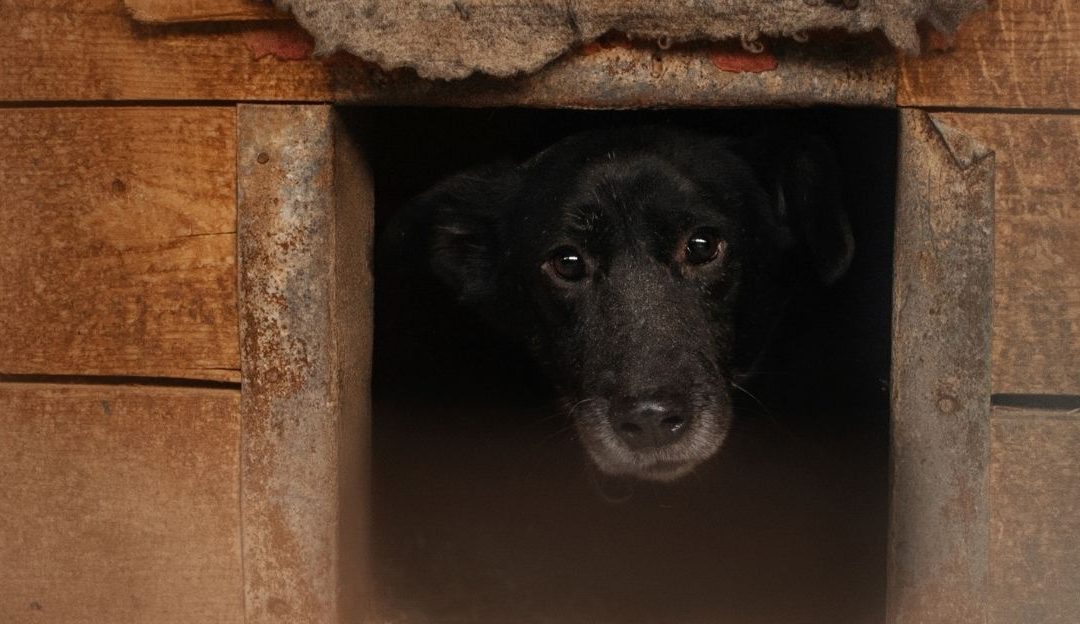
Black Dog Syndrome is a term used worldwide to describe a heartbreaking phenomenon: black dogs are adopted less often, end up in shelters more frequently, and are more easily abandoned or euthanized.
A black dog is often the first to be left on the street and the hardest to find a home for. This has nothing to do with the dog’s character; it is entirely about human projections, fears, and the symbolism we attach to color.
Black and White: Same Essence, Different Perception
In nature, black and white have equal value. A dog does not know whether it is black or white; it only knows whether it belongs or does not belong.
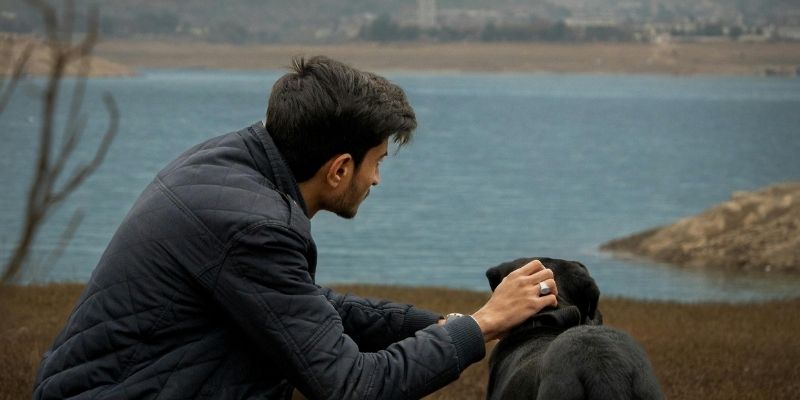
A dog does not know its color – it only knows whether it belongs.
The problem begins with human perception:
-
Viewing black dogs as „more dangerous.“
-
Believing they are harder to train.
-
Considering them „less photogenic.“
-
Projecting personal fears onto the color of their coat.
The Responsibility of Those Who Choose Black Dogs
Caring for a black dog carries a greater responsibility. Not because the dog is problematic, but because society’s attitude toward them is. Choosing a black dog is a conscious decision not to participate in collective rejection.
The Dog as a Mirror of Humanity
There is no animal that has suffered so much because of humans, nor one that has given us such unconditional closeness. The way we choose dogs says more about us than it does about them.
Every dog, regardless of color, seeks the same things: belonging, safety, and peace. A black dog is not a symbol of darkness; it is often a victim of the human fear of our own reflection.
This understanding of a dog’s emotional and physical state is at the heart of everything we do. At Integrative and Holistic Grooming Education, we teach people how to apply these principles of stability and care in their everyday lives with their dogs, helping create calm, healthy, and happy results.

by Sasha Riess | 26.01.26. | Wellbeing
Ear and tail docking in dogs is a topic often discussed superficially, without a true understanding of context and consequences. That is why it is important to say clearly from the start: docking a dog’s ears or tail is not a good practice when done without a medical reason.
A dog is not an object meant to be shaped to human aesthetic standards.
When Ear and Tail Docking Has Medical Justification
There are specific situations where surgical intervention is necessary for the animal’s well-being. If a dog has suffered a severe injury, a serious infection, a tumor, or permanent tissue damage, then removing part of the ear or tail is performed strictly as therapy.
In such cases, the procedure follows these principles:
-
Clear medical reason: The intervention is a response to an existing health issue.
-
Medical indication: It is recommended by a veterinary professional.
-
Health-focused goal: The priority is the dog’s recovery and quality of life, not its appearance.
In these instances, docking is not an aesthetic decision, but a medical necessity.
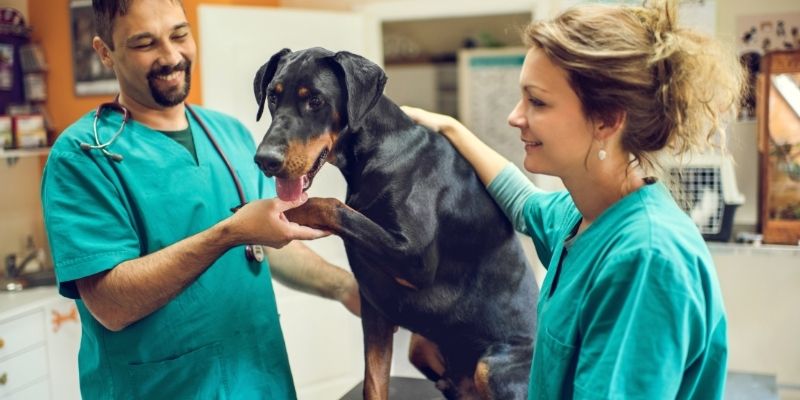
Intervention only makes sense when it resolves a medical health problem.
When Ear and Tail Docking Has No Justification
The problem arises when docking is done preventively or „in advance,“ simply because it is believed that the dog will „look better“ or should match a specific breed standard.
This practice has nothing to do with caring for the dog. Instead, it stems from a human desire to control and shape a living being according to arbitrary visual criteria.
Docking for aesthetic reasons:
-
Does not improve the dog’s quality of life.
-
Does not prevent future health problems.
-
Leaves permanent physical and psychological consequences.
A Dog Is Not Decoration, But a Responsibility
As a society, we have already made enough mistakes in how we treat animals. Every intervention on a dog’s body must have a clear medical justification rather than a visual motive.
A dog is not here to be „prettier.“ A dog is here to be healthy, stable, and safe. As owners and lovers of animals, our responsibility is to protect their physical integrity and respect them as sentient beings.