Artificial dog food is often presented as a practical and supposedly healthy solution, but its effect on a dog’s body is usually limited to short-term results such as “no visible symptoms.” The real issue is not whether the dog eats, but what actually happens inside the body during that process. If there is no digestion, there is no health.
How Artificial Dog Food Affects the Microbiome
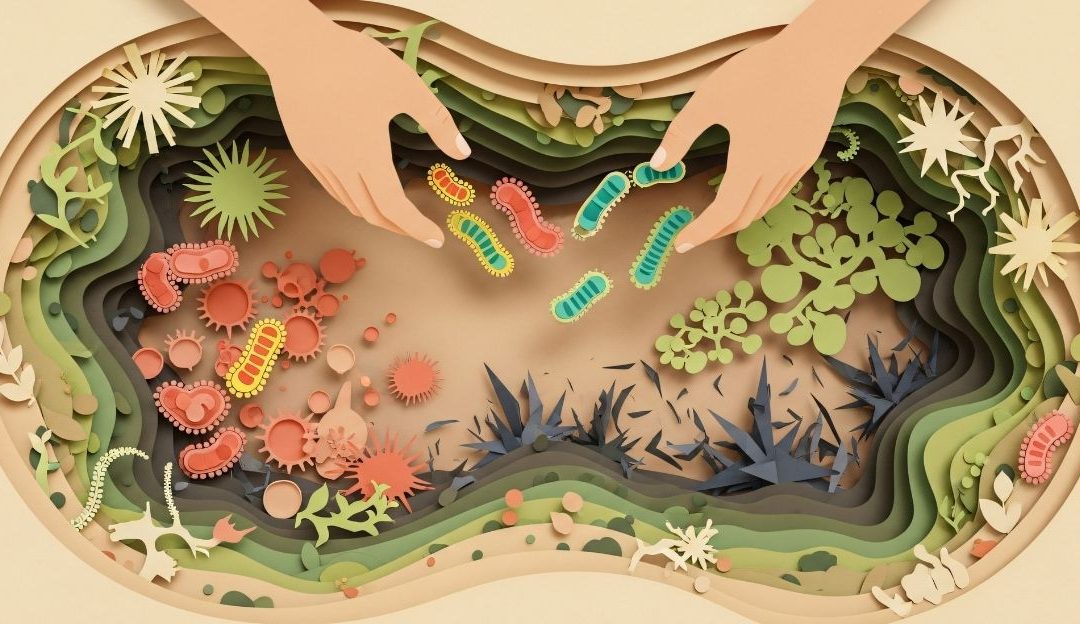
The essence of digestion lies in the microbiome. Without a microbiome, there is no digestion. Without digestion, there is nothing from food that can truly be absorbed.
In artificial dog food, almost everything is already broken down. Proteins, vitamins, and minerals are in powdered form. The body has no reason to engage. When the body does not need to digest, it does not activate the microbiome. And the microbiome does not exist only to break down food.
Why There Is No Immunity Without a Microbiome
The immune system lives in the microbiome. Not metaphorically, but literally. When the microbiome does not develop because the body does not need to digest food, the immune system remains inactive and weakened.
Artificial dog food therefore does not build resilience. Over time, it creates an organism that lacks the capacity to defend itself when serious issues arise, such as chronic inflammation, autoimmune processes, and severe diseases later in life.
Nature’s Law of Minimum Energy Expenditure
Nature functions according to the principle of minimal energy expenditure for maximum result. If the body receives ready-made substances that do not require breakdown, it will not invest energy in developing systems that appear unnecessary.
The problem is that the microbiome is not an optional feature; it is the foundation of health. When a dog becomes accustomed to food that does not require digestion, the body enters a state of passivity. Everything appears fine while the organism is young, but when aging begins, there are no developed defense mechanisms.
Industrial food does not require digestion—and for that reason, it does not build immunity.
How Industrial Nutrition Weakens Dogs Over Time
Industrial food does not require digestion, and for that very reason, it does not build immunity. Artificial dog food often seems like a solution because the dog eats, there is no diarrhea, and the coat shines. These are surface indicators.
Beneath them, resilience is not built. Adaptation is not built. A healthy relationship between body and food is not built. The microbiome and the immune system are either built through food or destroyed by it. There is no neutral option.
Not Convenience, but Responsibility
Feeding dogs is not a question of convenience. It is a question of responsibility. Food that does not require digestion does not stimulate life processes; it puts them to sleep. A healthy dog is not a dog without symptoms, but a dog with a system that knows how to defend itself.
At Integrative and Holistic Grooming Education, we teach that beauty begins in the gut. When you move away from artificial dog food, you choose to wake up your dog’s natural defenses. Discover the path to pureloveandharmony:Linktree Sasha Riess
When a dog adopted from a shelter arrives in a new home, many owners expect gratitude, affection, and quick bonding. Instead, the dog often seems withdrawn, sad, unsure, or completely distant. Understanding why a shelter dog appears withdrawn is a natural reaction from a dog who has had his entire world changed and still needs to understand where he has come and who you are in his life.
The Grieving Process of a Shelter Dog
A dog who has spent time without a stable home experiences the world differently. He does not see you as a savior, but as someone who has moved him from one unfamiliar environment to another.
Many dogs even want to go back in the first days, not because it was better there, but because the known always feels safer than the unknown. Their sadness is actually a form of grieving for the life they understood. Why a shelter dog appears withdrawn is often a direct result of this emotional stabilization process.
Giving Space Instead of Comfort
During this period, the dog may seem lost, inactive, or completely distant. The healthiest approach is to give him space. You should not comfort him immediately or force him into interaction.
Feeding Rituals as the Key to Trust
In the first days, you should not overwhelm the dog with attention. Instead, use feeding rituals that give the dog structure and predictability. Through this small but powerful ritual, the dog begins to understand that you are a figure of stability. This is the most effective answer to why a shelter dog appears withdrawn: they lack a point of reference, and you are building that through routine.
Why You Should Not React Immediately
When the dog finally gathers the courage to come to you, do not react impulsively. Do not pet him right away or praise him loudly, as this can frighten him. Instead, wait for him to calm down. This teaches the dog that interactions with you are stable and predictable.
Keeping distance is a normal phase of adjustment for a dog adopted from a shelter.
The Biggest Mistake: Too Much Attention
Many people, with the best intentions, constantly approach the dog. But a dog does not experience this as support. To understand why a shelter dog appears withdrawn, one must realize that too much attention increases their stress. He does not need to be overwhelmed with emotions; he needs routine, structure, and quiet.
In the Sasha Riess philosophy, we believe that the greatest gift you can give a rescued animal is the right to their own silence. When you understand why a shelter dog appears withdrawn, you provide the foundation for pureloveandharmony. Discover more: Linktree Sasha Riess
When a dog refuses to come when called, especially outdoors, many owners immediately assume they are doing something wrong. However, the dog is rarely “disobedient.” Most of the time, the dog is making a decision based on the dynamics of the relationship with the owner and on past experiences. Understanding why a dog refuses to come is the first step toward building a reliable recall.
The Foundation: Why a Dog Refuses to Come at Home
For a dog to truly want to come when you call, the exercise must begin at home. A refusal to come is never accidental; it always has a reason rooted in structure—or the lack of it.
The first step is establishing a clear feeding ritual. After you take your bite and prepare the dog’s meal, take a few steps backward and call your dog to come to you. Even if the dog is already following you, it is important to say the command and then place the food down. When the dog finishes eating and moves away from the bowl, you lift it.
This creates structure and teaches the dog that your invitations have meaning, addressing the core issue of why a dog refuses to come by establishing you as the source of valuable resources.
The Sacred Channel of Communication
Rewards are a powerful tool, but only when used correctly. A “treat” should not be something that is constantly available. It should be a reward earned through a specific behavior. That is why it is ideal for the dog to receive a reward every time it comes when called, and never in any other situation.
Food is, for dogs, a sacred channel of communication, and it should be used with intention and clarity. Through this process, the dog learns that coming when called always brings something positive—a predictable and safe behavior.
Training a reliable recall always begins at home, far before attempting the park.
Extending the Ritual Outdoors
Once you establish these rituals at home, they gradually extend to outdoor situations as well. Keep in mind that a dog does not ignore your call “on purpose.” The dog simply follows what its inner experience tells it is more important in that moment.
When you wonder why a dog refuses to come in the park, it is usually because the environment is more rewarding than the owner. Your task is to make your call the most valuable signal in your dog’s environment through consistent home-based rituals.
At Integrative and Holistic Grooming Education, we believe that every command is a conversation. When you understand why a dog refuses to come, you stop fighting and start connecting. Discover the path to pureloveandharmony: Linktree Sasha Riess
From years of observing dogs, I often notice moments when a dog suddenly becomes completely still. At first glance, he appears calm or uninterested, but behind that outer silence lies a complex psychological and physiological process. Understanding why a dog freezes is essential for any owner who wants to build a relationship based on trust.
Dogs and Stress in Their Environment
Dogs constantly sense our energy and tension. Even when an owner says they are calm, the dog can feel the tension in the air. This is an instinctive reaction. In such moments, the dog activates the motor response known as fight, flight, or freeze.
This means the dog can run away if there is space, attack if he sees an opportunity, or completely freeze if he sees no way out.
Why a Dog Freezes Instead of Running
Dogs often cannot escape because they are on a leash, inside the home, or in a restricted space. When an aggressive response is suppressed due to training or socialization, the only remaining option is freezing.
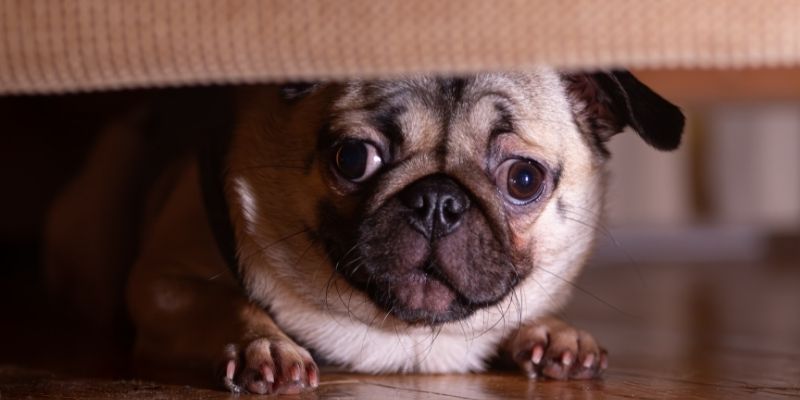
When you wonder why a dog freezes, remember it is the way a dog processes stress and holds the tension inside because he has no way to release it physically. It is not laziness or disobedience; it is a moment of self-protection and a way of dealing with insecurity.
When space is restricted: A dog on a leash has no other option but to freeze when stressed.
How to Support a Frozen Dog
The dog uses internal energy to stay in control. It is a sign of intelligence, but also a warning that he needs support.
My Advice for Dog Owners:
Do not respond with anger: Frustration only increases the dog’s internal stress.
Provide safety: Create a place where the dog can withdraw and feel secure.
Observe early signs: Look for signs of tension (like stiffening or „whale eye“) before the freeze occurs.
Stay calm: Your patient and calm energy is the best tool to help the dog relax.
Understanding why a dog freezes is essential for the dog’s well-being. Even if he doesn’t show aggression, his stillness is a clear sign that he senses a threat in the environment that he cannot resolve alone.
At Integrative and Holistic Grooming Education, we teach that silence is a language. When a dog freezes, they are speaking to us about their need for safety and pureloveandharmony. Learn to listen: Linktree Sasha Riess
When a dog refuses obedience, most people assume something is wrong with the dog. But the truth is much deeper. I first encountered the idea of a culture of conflict through the work of my mentor, systemic therapist Vlado Ilić, who taught me that conflict is not a mistake but a natural process of growth.
Every conflict, even the one that appears between a human and a dog, is actually an invitation to look deeper into ourselves and face what we suppress.
Why Disobedience Is Not a Problem with the Dog
The culture of conflict teaches that conflict is not a flaw in a relationship but a natural occurrence that carries within it the possibility of growth and development. Every conflict is an invitation to look deeper, to see what we suppress, and to grow into more complete human beings through that encounter.
The clash between human and dog is often a reflection of our internal emotional conflict.
What Happens When a Dog Refuses Obedience
In practice, this becomes very clear. We often see conflict when a dog refuses obedience or does not do what we expect. Instead of stopping and asking why, we rush into training, forcing the dog to adapt to our demands. In doing so, we repeat the same patterns of force and upbringing that we once promised ourselves we would never repeat.
Dogs as Mirrors of the Human Shadow
This is not a conflict with the dog; it is a conflict with ourselves. It is a struggle with the part of us we do not want to acknowledge, the part whose longing for freedom becomes visible through a “disobedient” dog.
Dogs help us because they demand presence. They do not know masks. Their reaction is always authentic. When we learn to remain present in conflict with a dog, not resorting to punishment or force, but asking what the dog’s behavior is showing us, we touch the essence of harmony.
The Order of Love and Systemic Balance
Family constellations work with systemic laws, described by Bert Hellinger as the Order of Love. The three principles are:
The right to belonging: The dog belongs in our life, but not as a projection.
Respect for order: The human carries responsibility through grounded leadership.
Balance of giving and receiving: The dog is not a toy; he must receive safety, clarity, and love.
Silence and presence allow conflict to become a gift rather than an obstacle.
Presence and Silence: How to Respond
If I had to choose one practice for when a dog refuses obedience, it is to learn how to listen in silence. Not to listen through a mask or the ears of our parents, but through our own being. This means pausing before reacting, taking a breath inward, entering silence, and only then responding.
In my years of working with dogs, I have grown the most in conflict. Every crack in a relationship can become a place where light enters. If we dare to see conflict as a gift, it becomes a teacher rather than an enemy.
At Integrative and Holistic Grooming Education, we view every challenge as a path toward pureloveandharmony. When a dog refuses obedience, they are leading you toward your own shadow. Embrace the lesson:Linktree Sasha Riess
In everyday life with dogs, play is often taken for granted as something always good, something that releases energy, brings joy, and strengthens the bond. But why is play not just play?
The Primal Nature of Play: The Endless Hunt
To understand the power of play, we must go back to its origin. The dog is a descendant of the wolf, a hunter whose survival depended on reenacting hunting behavior. For a dog, the motion of a thrown ball carries the same signal as prey.
In nature, this ritual always has a clear end. When the prey escapes or is caught, the cycle ends. In domestic life, when the prey keeps returning, the cycle never closes. The ball comes back again and again, and the instinct remains open. It is like a wound that never heals.
When constant stimulation floods the dog’s nervous system — instead of play, unrest arises.
Cortisol and the Cycle of Excitement
Modern science shows that excessive stimulation leads to chronic cortisol release—the stress hormone. A dog that chases balls every day falls into a loop:
The more we activate the hunting instinct, the stronger the excitement.
The harder it is to calm down, the more the dog seeks new stimulation.
This is not simple joy; it is a form of addiction similar to the human need for adrenaline.
Play as a Ritual, Not a Habit
In the Harmony Handbook, we teach that rituals create rhythm between tension and release. For play to serve as a true ritual, it must be controlled. A simple rule: any game that activates the hunting instinct (balls, frisbee, tugging) should be rare and structured—perhaps once a week, not daily.
Calm Play: The Power of Touch and Presence
If we reduce play solely to chasing, we miss its deeper meaning. Calm play—such as gentle touch, chest scratching, or soft brushing—is often what the dog values most. During these moments, cortisol decreases and oxytocin, the hormone of connection and safety, increases.
Consequences of Misguided Play
Many owners do not connect behavioral problems with the way they play. Pulling on the leash, barking, or even urinating in the house are often symptoms of an overwhelmed nervous system. When the body is stuck in „fight or flight,“ the dog cannot regulate basic needs.
Calm rituals and touch — the most powerful way to reduce stress and strengthen the bond with your dog.
Practical Advice for Conscious Play
Structured hunting play once weekly: Keep it short (3-5 minutes).
Remove constant reminders of prey: Do not leave balls within the dog’s permanent reach.
Daily calm rituals: Prioritize touch, grooming, and quiet rest.
True harmony does not come from constant pursuit of excitement. It comes from balance, awareness, and the tenderness through which relationships are built.
At Integrative and Holistic Grooming Education, we teach that peace is the ultimate goal. If your dog is trapped in a cycle of high arousal, it’s time to return to the basics of presence. Explore the pureloveandharmony approach:Linktree Sasha Riess
A sold life begins the moment we hand our choices over to other people’s expectations, fear, or money. How many times have you told yourself: “I have to stay in a relationship I do not love, because of money” or “I have to work a job I hate”? These are all examples of how justifications lead to a sold life. What you truly have to do is face your own justifications. Because justifications are the currency we most often use to pay for a sold life.
How Justifications Lead to a Sold Life
Excuses are sophisticated. They sound reasonable, realistic, even noble. “I have to because of money,” “I have to because of the children,” “I have to endure it, that is how I was taught,” or “Better something than nothing.” But every one of these excuses has a price: your freedom. And so, little by little, life becomes a chalkboard that others write on instead of you.
Selling Ourselves for the Illusion of Security
Social media, movies, and other people’s lives all sell the same illusion—that happiness will come through money, stability, career, and a so-called proper life. But the truth is brutal and simple: that happiness never comes the way it was promised. You can have money, you can have status, you can have a perfect profile, but if the price was a sold life, everything remains hollow.
Pull the Handbrake and Stop Selling Your Life
What you do from the soul, from meaning, from integrity, that is what truly nourishes you. That is the only thing that brings peace. The strongest criticism, mockery, and resistance always appear when I am on the right path. Not because I am wrong, but because others feel their own stagnation. When I am criticized on both Serbian and English platforms, I know I am touching truth. And truth rarely leaves anyone indifferent.
Every justification has a price—we most often pay it with our own destiny.
Why Do You Keep Braking When It Is Time to Accelerate
Most people pull the handbrake when fear appears—fear of change, fear of judgment, fear of failure, fear of other people’s opinions. But the truth is that you are most alive when you release the brake. When you stop trading yourself for expectations that were never truly yours.
Your Justification or Your Freedom
We all have justifications, but we do not have to live by them. We can recognize them, dismantle them, and decide to stop selling our time, our emotions, and our destiny for a fragment of false security. Freedom never comes through money, applause, or social norms. Freedom comes the moment you stop selling yourself.
So the question remains: What is your justification?
At Integrative and Holistic Grooming Education, we believe that authenticity is the highest form of energy. Whether in life or in your relationship with your dog, truth is the only path to harmony. Stop braking and start living:Linktree Sasha Riess
Many owners wonder when to groom a puppy for the first time and whether there is a “right moment” to get the puppy used to bathing, trimming, and blow drying. The truth is that most puppies accept grooming much faster and more easily if it starts early, even before six weeks of age. Early grooming is not just a hygiene routine; it is an important part of raising a stable and confident dog.
When to Groom a Puppy: The Optimal Time
The best time for a puppy’s first grooming can be even before six weeks of age, especially in breeds that grow hair quickly or have long, soft coats. Many breeders begin gentle care as soon as the puppy opens its eyes and starts nibbling solid food, sometimes as early as the third week. At that stage, puppies begin to separate from the mother, get dirty, and enter a phase where a first light hygiene routine becomes necessary.
How to Prepare a Puppy Before Grooming
When grooming starts early, the puppy quickly learns that touch, water, a blow dryer, and clippers are a normal part of life. Dogs that go through gentle grooming processes from a very young age later accept grooming, veterinary visits, nail filing, and handling much more easily. If grooming is postponed for too long, a puppy may develop resistance, fear, or nervousness.
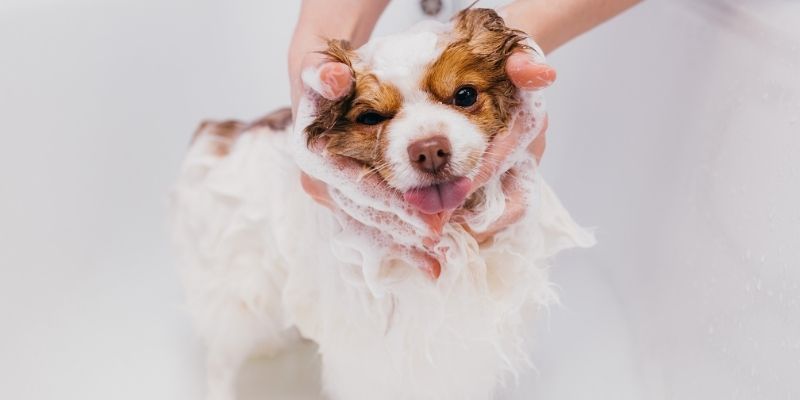
Early bathing helps a puppy experience grooming as a normal part of life.
Tips for Regular Grooming and Habituation
Habituation should be gentle, short, and positive. The first grooming session should not last long; just a few minutes is enough. A simple routine includes:
Briefly touching the paws and muzzle
Lightly trimming hair around the eyes or paws
Short blow drying without directing air at the head
Bathing only with warm water and gentle movements
The Most Common Mistakes in Puppy Grooming
Waiting until the puppy is four to six months old, which is too late.
Making the first grooming session too long.
Forcing the puppy if it becomes restless.
Using a blow dryer that is too strong.
Negative reactions from the owner that create tension.
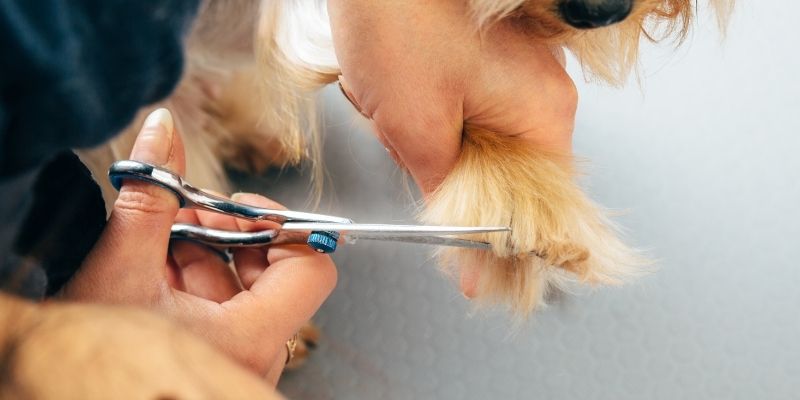
Trimming the paws is the first step in teaching a puppy to accept touch and care.
How to Make Grooming a Stress-Free Routine
The most important thing is to stay calm. The puppy should feel that grooming is a normal part of life, not a special event. If you are wondering when to groom a puppy, the answer is as early as possible, but gently and gradually. Early habituation makes a huge difference and helps build a dog that accepts grooming calmly throughout its entire life.
At Integrative and Holistic Grooming Education, we believe that early care is the foundation of pureloveandharmony. By introducing grooming as a natural routine, you are giving your puppy the gift of stability. Learn more about our approach: Linktree Sasha Riess
There are moments in the relationship between a human and a dog that seem almost insignificant, yet they contain the entire truth about who we are.
A Bond That Is Not Measured by Words
We stand and call the dog. He starts walking toward us, then stops halfway. He looks at us and waits. That moment of silence reveals far more than any command ever could. It is not a struggle of strength, but a struggle of presence. Who will give in first. Who will take the step. If we move toward him, we lose leadership. If we remain calm, we become a source of safety.
Leadership in a relationship with a dog does not mean dominance. It means becoming a point of support. The dog does not seek a master, but stability—someone who carries order within themselves.
The Dog as a Mirror: The Price of Carrying Someone Else’s Unrest
In such relationships, the dog becomes our emotional regulator. When our heart races with anxiety, he lies next to us. But every system that reverses roles carries a cost. When a dog takes on a role that belongs to a human, he slowly begins to carry a weight that exceeds him. His nervous system begins to respond to our emotions.
That is why it is no coincidence that many dogs develop conditions that reflect the state of their owners. Heart problems, allergies, and anxiety are often expressions of the dog paying the price for our lost sense of safety.
The dog takes over our inner unrest. Its body begins to live our unconscious.
Leadership in Silence: A Lesson in Trust and Stability
When the dog stops and looks at us, a mirror of our history opens in front of us. Do we know how to stay? Leadership is an act of silence. It begins when we no longer need to prove that we are leading. Love without boundaries is not love; it is confusion. When we learn to stand, not out of pride but out of trust, we restore order both to ourselves and to the dog.
Leadership is not an act of power, but an act of silence and stability. When you stand, the dog will come.
When the Dog Trusts, Order Returns
The next time your dog stops and looks at you from a distance, do not rush. Do not go toward him. Stay. Breathe. This is not a test of obedience; it is an invitation to check where you are. Because if you stand, he will come. Always. And when he comes, he does not come to submit, but to surrender. That is the moment when love stops being a need and becomes a relationship.
The dog becomes a dog again, and the human becomes human again. Energy flows in the right direction, calmly and without effort. True love never demands proof, only peace.
At Integrative and Holistic Grooming Education, we understand that the energy you project is the most powerful tool you have. When a dog stops and waits, they are asking for your stability. Find your inner peace and restore pureloveandharmony: Linktree Sasha Riess
When a dog is left alone at home and begins to cry, howl, scratch the door, or destroy items, many owners think it is simply “being spoiled.” However, in most cases, this behavior is separation anxiety, a deep fear that the owner will not return or that the dog has been abandoned.
This problem is common, but often misunderstood. Out of good intentions, owners start sacrificing their own life, staying home, avoiding plans, and adjusting everything to the dog, believing it will help. But this actually makes the problem worse.
Why Excessive Sacrifice Hurts the Dog
Dogs that suffer when left alone are not just “sad.” They are anxious, and the anxiety becomes stronger each time their fear “works.” When the owner avoids obligations or returns quickly because the dog cries, the dog receives the message: “You are right to be afraid. The world is dangerous without me.”
Dogs do not want us to sacrifice ourselves. They want a stable, calm, confident human who shows them that leaving is normal and returning is certain.
Secure Attachment vs. Separation Anxiety
Dogs with secure attachment can stay alone because they know the owner always returns and they feel they are in a predictable routine. On the other hand, a dog with separation anxiety experiences panic. To them, the owner has disappeared forever. This results in:
Urinating or defecating indoors
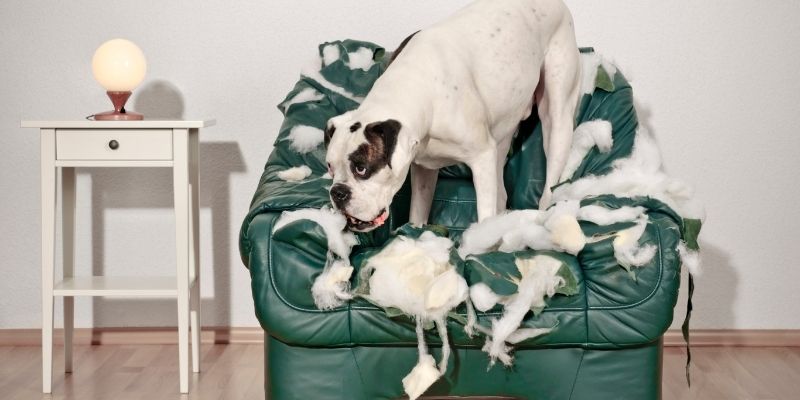
Chewing furniture or belongings
Scratching doors until injuring paws
Trembling, whining, or circling endlessly
These are not “bad habits”; this is a physiological response to fear.
Teach independence while you are at home: Practice short “stay” exercises in different rooms.
Do not return because the dog is crying: This reinforces fear. Return only when the dog is calm.
One Important Truth Every Owner Should Know
A dog who cries when left alone is not spoiled; the dog is scared. But a dog who cannot stay alone is not happy; the dog is dependent. And dependence is never love. Love is safety, trust, and the freedom for a dog to stay calm even when you are not there.
At Integrative and Holistic Grooming Education, we teach that a balanced dog starts with a balanced owner. Separation anxiety is an energetic knot that can be untied with the right approach. Restore the pureloveandharmony in your home:Linktree Sasha Riess